
Tourist-Third Cabin on R.M.S. AdriaticMost of those who travel under this new plan will find themselves in cabins superior to any previously occupied by Tourist passengers. The largest of White Star's 'Big Four' liners, Adriatic's second class had offered a cut above the market when introduced in 1907. Upon her conversion to a 'Cabin Liner' in 1928, Tourist-Third passengers found these rooms their new domain. Third Class passengers also saw substantial improvements to their accommodations including a new suite of modern public rooms. During her ever popular cruises, Tourist Third accommodation stretched the entirety of what had formerly been both Second and Third Class.
|
Tourist-Third Smoking Room
As a result of the reclassification of the Adriatic as a Cabin Liner, the entire accommodation once designated as Second Class was transferred to passengers in the Tourist-Third Cabin. The Tourist-Third (formerly Second Class) Smoking Room was situated in a separate deckhouse aft of Deck B. This apartment was furnished with large fitted seating upholstered in red-brown leather. Small pairs of writing desks were provided accompanied by swivel armchairs, screwed to the floor in the fashion which was once standard throughout the ship. The walls were decorated with oak paneling and walnut dado railings which framed small yet brightly decorated stained glass windows overlooking the promenade deck. An eccentric feature of this room was the post running through the middle which supported the furthest aft of the ship's masts on top of the deckhouse. Although this reduced some of the floor space, overall it did not detract from the ample proportions of the room.
Tourist-Third Library
|
Aft of the Cabin Class staterooms, an additional deckhouse contained the Library for Tourist-Third (formerly Second Class) passengers. The Library was located directly below the Smoking Room with Decks, B, C, and D being connected by a broad, sweeping style of staircase. As in the apartment above, the base of the aft-most mast cut through the middle of the room. The Library was spacious and well-ventilated. The room was pannelled in satinwood with inlaid panels whilst the windows were decorated with stained glass. A plentiful quantity of mahogany furniture was provided, fitted to the floor and upholstered in floral-pattered fabric. A generously sized bookcase contained a number of volumes which were available to loan by the passengers.
|
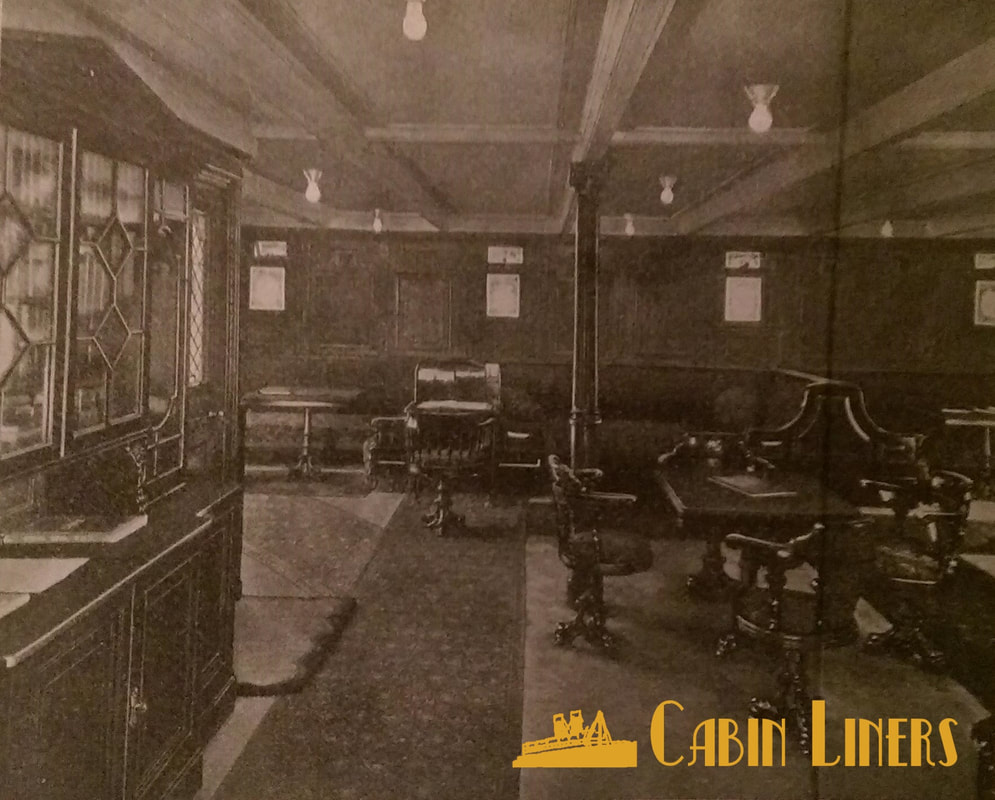
Library for Tourist-Third (formerly Second Class) passengers. Deck Plan; 1933.
|
Tourist-Third Lounge
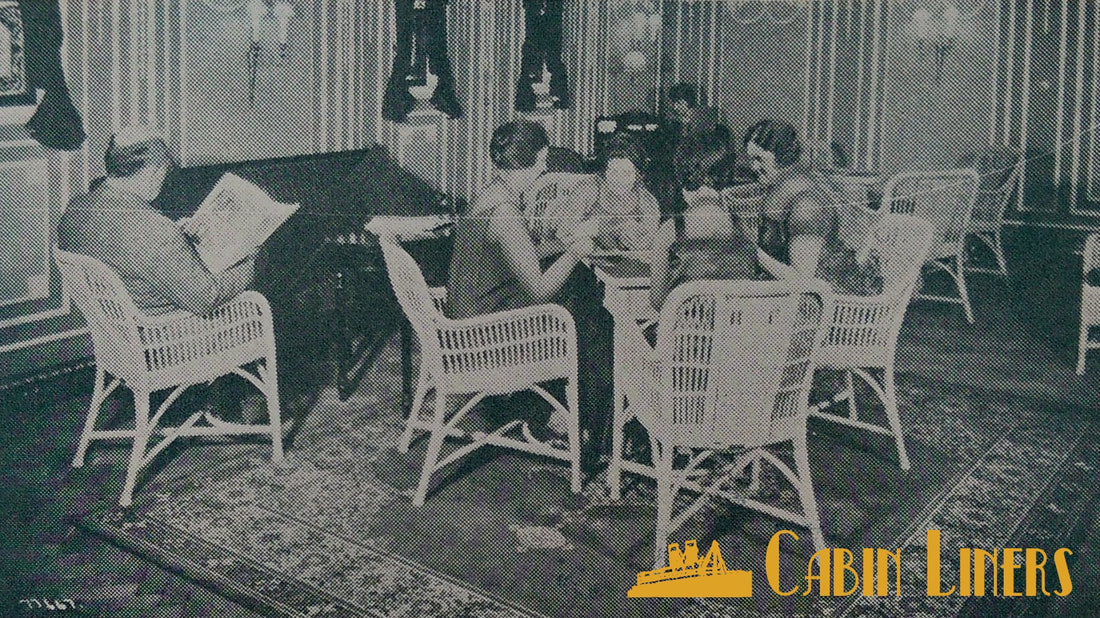
Aft Lounge. "Largest Steamers To and From Ireland" brochure; 1927.
|
Farther aft of the Tourist-Third Library was an additional deckhouse containing a specially build Tourist-Third Lounge. Originally designated as a promenade deck for Third Class passengers, the open deck was enclosed to build the new Lounge during Adriatic's refit in 1929. Considerably more modern in taste in comparison with much of Adriatic's Edwardian era accommodation, the room was decorated in a light colour scheme, furnished with bright wicker furniture, and fitted with a piano and gramophone.
|
Third Class Public Rooms
|
A spacious set of public rooms was provided for the comfort of Third Class passengers at the stern of Deck D to the rear of the Tourist-Third entrance and staterooms. These rooms had not been included in Adriatic's original design. They were installed in 1921 after her re-entry into service following the First World War. Third Class accommodation was equipped with a new lounge, smoking room, barber's shop, and children's playroom at the expense of a number of Third Class births and over-spill dining space. These had been rendered surplus to requirements following the decline in European migration to the United States after 1919, leading the company to focus on modernizing Third Class accommodation to meet the needs of new categories of budget traveler.
|

Adriatic's new Third Class Children's Playroom. "Boston & New York: Third Class" Brochure; c.1930.
|
The decoration in these public apartments was plain in comparison to the other classes yet noted for being comfortable, bright, and generous in size. The decorative scheme consisted of half-height teak paneling with the upper walls and ceiling painted cleanly in white. A vast improvement over the fixed swivel seating and long tables of the pre-war period, the new public rooms were fitted with small tables surrounded by large wooden armchairs. The walls were decorated with paintings and the rooms was brightly lit by modern lighting and an extensive number of portholes. A large bar extended between the lounge and smoking room sections. Cards, board games, and newspapers were provided along with a piano and gramophone for passengers' use. During cruises, when Third Class accommodation was not offered, these rooms were made available to Tourist-Third passengers.
Tourist-Third Dining Saloon
The dining saloon for Tourist-Third passengers was located slightly rear of amidships between the two principle blocks of Tourist-Third staterooms. At full capacity, the dining saloon accommodated two-hundred-and-fifty diners and it had changed little since its original use by Second Class passengers. The dining saloon was decorated with half-height oak paneling, the upper walls being fitted with simply carved wood paneling painted in white. It was furnished with long wooden tables accompanied by upholstered swivel armchairs. These dining chairs were fixed to the floor as had been customary when the Adriatic entered service. A piano was fitted in a large wooden niche along the forward wall. By 1930, the tables and seating along the middle of the dining saloon had been removed to accommodate a dance floor. Freestanding wicker furniture was included in the space, giving the room flexibility to be the used for a variety of functions.

Tourist-Third Dining Saloon. Deck Plan; 1929.
Third Class Dining Saloon
A large dining saloon for Third Class passengers was situated directly below the Third Class public rooms and aft of the Tourist-Third dining saloon and staterooms. This room was divided into two equally sized sections by the main Third Class staircases running through the middle. Decorated in teak paneling and plain white painted walls, the room was significantly improved in 1921 by the division of the original long tables into a smaller seating arrangement. Paintings of nautical scenes were hung from the walls and the tables were decorated with plants and plain yet bright table linen. Seating took the form of plain wooden swivel seats affixed to the floor.
Tourist-Third Staterooms
Staterooms for Tourist-Third Cabin were located on Decks D, E, and F in former Second Class accommodation. Staterooms were designed to accommodate two, three, or four passengers and were fitted with comfortable wooden berths, fitted upholstered seating, and washbasins. Those located on Deck D were alterable between Cabin and Tourist-Third Cabin and therefore tended to provide somewhat more comfort than those on the lower decks. Following general improvements in passenger accommodation in the late 1920s, White Star made further effort to improve passenger comfort by ensuring electric heating and hot and cold running water in all Tourist-Third staterooms.

Third Class cabin as advertised in Adriatic's early career, showing the plain but comparatively comfortable standards of the time. Travel Magazine; 1909.
|
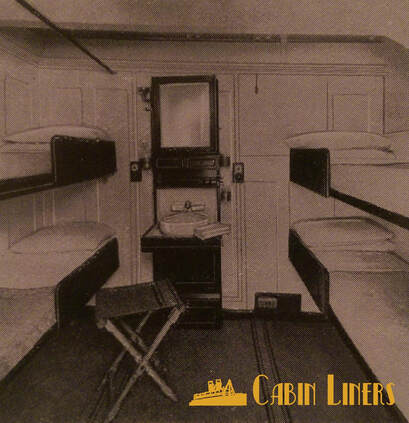
Later advertising shows the improved standards of Third Class accommodation. "Boston & New York: Third Class" Brochure; c.1930.
|
Third Class Cabins
As originally laid out, Third Class cabins were located in two sections fore and aft across Decks D, E, and F. The size of cabins varied considerably to accommodate anything between two and ten passengers. Decoration was plain yet functional and the 'Big Four' developed a reputation for their Third Class accommodation being comfortable and well-kept. The cabins walls were painted in plain white. They were fitted with metal bunks and each cabin was supplied with coat hooks, mirrors, electric lighting, steward call buttons, and ample luggage space. Upon entering service, they represented a significant improvement upon the steerage accommodation of less than a decade prior. Some Third Class passengers were accommodated in large dormitories but these were removed from 1919 onward in favor of private staterooms and modernized public rooms. Further improvements were made in 1929 including newly fitted washbasins with running water, updated light fixtures, and more modern berths.