
First Class on R.M.S. AquitaniaThere can be no more fitting preparation for the intelligent enjoyment of the art galleries, the ancient landmarks, and the old-world mansions of England than a careful examination of the treasures to be found on the Aquitania, in the arrangement of which taste and dignity play an equally important part. Aquitania was distinguished by the rare beauty of her interiors, the inspiration for which was drawn directly from the great houses of England, representing the best of every age of English architectural history. This Old World elegance remained endearing to her First Class passengers, who found themselves surrounded by the art and society of Europe afloat on the North Atlantic.
|
First Class Drawing Room
The Drawing Room was the furthest forward of the magnificent suite of public rooms on A-deck. Accessing the room from the main Entrance Hall, First Class passengers found themselves entering an elegant eighteenth century apartment in the style of the Adams brothers, representing the best period of their design from 1780. The walls were hung with blue tabourette silk and decorated with fluted pilasters in the classical style. A frieze carved with scrolled foliage surrounded the top of the room. This was complimented by a richly carved dado rail with design motifs inspired by the Adams brothers work at Lansdowne House in Berkeley Square, London. The space was neatly divided into two areas by a series of impressively carved Corinthian pillars. The most impressive feature of the Drawing Room was undoubtedly the large oval dome in the port-centre of the ceiling. Natural light entered through the dome by means of a series of lunette windows which were fitted with lead moldings and detailed plaster ornamentation.
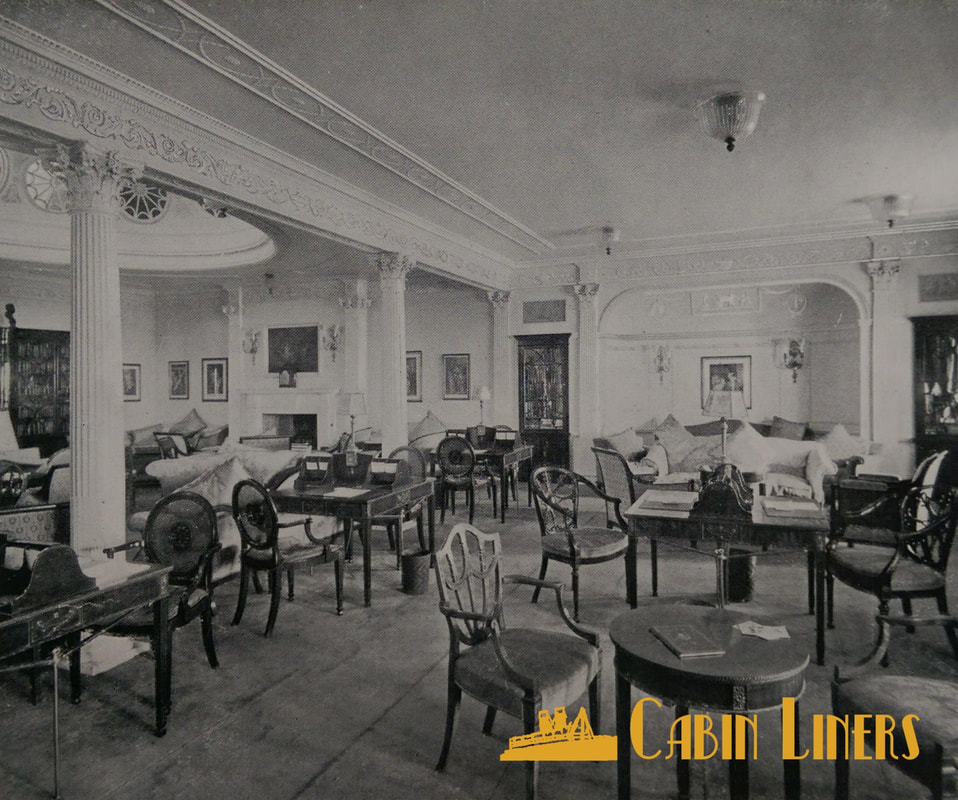
First Class Drawing Room aboard R.M.S Aquitania. "L'Aquitania: La Huitieme Merveille du Monde" brochure; c.1925.
|
When the "stranger within our gates", who has had the good fortune to travel by the Aquitania, happens to pass through Fitzroy Square, or look on the screen before the Admiralty in White-Hall, or admire the fine façades of the mansions in Portland Place, he will be forcible reminded of the Adam drawing-room of the Ship Beautiful. "The Ship Beautiful: Art and the Aquitania"; 1914
|
The elegance of the decor was further enhanced by the quality of the fixtures and furnishings. The doors were carved from Cuba mahogany complimented by several large bookcases produced from the same wood. The room was furnished with gilded mahogany console tables, writing tables with Queen Anne chairs, and large settees and armchairs upholstered in soft blue fabrics. A large blue carpet topped with Persian rugs neatly complemented the decorative scheme. A central feature of the room was the fireplace, surrounded by a mantelpiece carved from statuary marble and decorated with a figured frieze. In keeping with the architectural style, the room was fitted with generously sized windows overlooking the enclosed promenade deck. The walls were hung with mezzotints of famous eighteenth century female beauties as well as other notable figures of the era such as George III and Queen Charlotte of Great Britain, Samuel Johnson, Benjamin Franklin, George Washington, and Edmund Burke.
First Class Entrance & Salons
The main decks of First Class accommodation were connected by an impressive Main Staircase decorated in Louis XVI style. Ascending this staircase to A-deck, passengers arrived in a stunning Entrance Hall, providing access to the principal public rooms on this deck. The gracefully carved wood panelling was painted in French grey, with gilded accents decorating the edges of the detailing. The ceiling of the Entrance Hall, supported by tall Corinthian style columns, was topped with a vast wrought iron and glass skylight. This allowed natural light to descend through the open-well down onto the various levels of the staircase. The staircase itself was fitted with a richly decorated wrought-iron ballustrade painted in gold. The flooring consisted of black and white tilling topped with a plush Persian carpet. A large painting by Pannini, showing Rome's ancient ruins, was hung on the upper landing. Below this was fitted a bas-relief in the style of Clodian which depicted Cupids playing amongst dolphins and sea-shells. Across from the staircase, two electric elevators with elegant wrought iron gates connected A-deck through E-deck.


Leading aft from the Entrance Hall towards the Lounge, passengers passed through one or other of the two vestibules or 'Salons' which acted as communicating corridors as well as additional writing rooms. These were located on the port and starboard side respectively, divided by the elevator shaft and the No.2 funnel casing aft of the Main Staircase. The decorative style of these rooms was Louis XVI corresponding to the adjoining Entrance Hall. The walls were painted in French grey with gilded detailing whilst the flooring was fitted with camel-coloured oriental carpets topped with Persian rugs. On the inner wall of each apartment, there was a large recess fitted with a mirror in the style adopted at the Palace of Fountainbleau. Two large painted panels were also fitted, one on either side of the recess, showing reproductions of the works of Hubert Robert. Tall windows extended the length of the outer wall. Generously sized mahogany and ormolu writing tables were place here, providing views into the Garden Lounges.
First Class Palladian Lounge
The principal public room on A-deck was the Lounge which was accessed aft of the Entrance Hall through either of the two connecting Salons. The decorative scheme adopted in this apartment was Palladian, exemplifying the style popular in the late Restoration period during the reign of William III & Mary II. The work of the English gentleman architect Sir Christopher Wren was the primary influence upon the design of the Lounge. The architectural form of the room was defined by two sets of Ionic columns, creating a central hall flanked by two more sheltered sections on either side. The central section had a total height of eighteen feet created by a lofty waggon-headed ceiling rising above the middle of the room. Lunette windows with Tijou style ironwork were fitted within this vault. The ceiling itself was intricately decorated with ornamental plasterwork together with large painted panels representing the four classical elements - 'Fire', 'Earth', 'Water', and 'the Heavens'. Fitted within the middle of the ceiling was an original oil painting on canvas by the artist Van Cuygem, its scene aiming to depict the power and prosperity of Amsterdam.
No sooner is the threshold of the great central hall of the Aquitania crossed, that you realise the consummate taste and extraordinary skill with which this marvellous reproduction of some state apartment of the time of William and Mary has been contrived and carried out. "The Ship Beautiful: Art and the Aquitania"; 1914
|
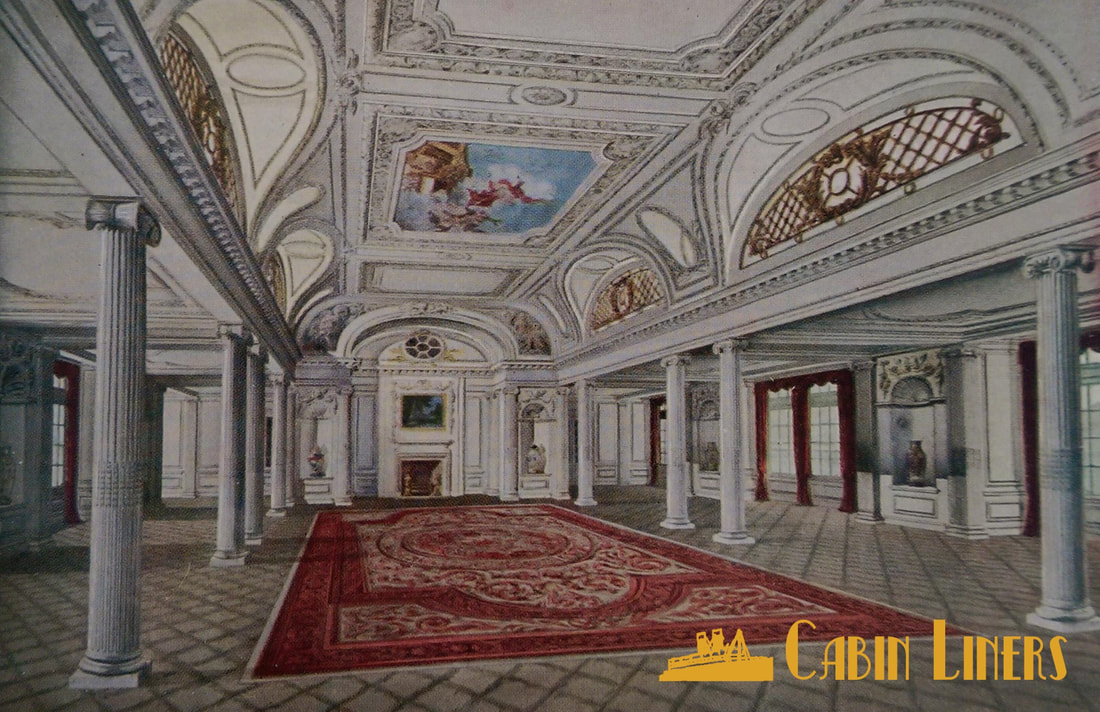
First Class Palladian Lounge. "R.M.S. Aquitania: Interior Views" bochure; c.1914.
|
The colour scheme of the Lounge was red-wine and caledon grey and the room was fitted with oak parquetry flooring. This was designed to be suitable for dancing although it was usually covered by a hand-woven Savonnerie style carpet in red and cream colours. On the aft wall of the Lounge, a semi-circular recess was fitted with a stage and grand piano. This allowed the room to be used for concerts or dramatic performances in additional to its regular function as a social space. This recess was topped by a coffered ceiling, below which was hung a large reproduction Mortlake tapestry showing the Battle of Solebay during the Third Anglo-Dutch War. Directly opposite from this stage recess, the Lounge was fitted with a large fireplace framed by beautifully figured panels of Breccia Africane marble. Niches around the room held urns and classical marble statues whilst the walls were adorned with delicately carved decorations of fruits, foliages, and game birds. The furnishings were upholstered in plum coloured damask.
First Class Garden Lounges

Garden Lounge "L'Aquitania: La Huitieme Merveille du Monde" brochure; c.1925.
|
Amongst the most popular features available to Aquitania's First Class passengers were the Garden Lounges located on either side of A-deck. A Garden Lounge was fitted on both the port and starboard sides directly overlooking the sea and extending across the length of the Entrance Hall, Salons, and Palladian Lounge. These airy apartments were decorated to resemble sheltered old gardens, providing passengers with a space to enjoy the view of the passing ocean whilst taking refreshments and engaging in light conversation. The walls were fitted with trellises made from natural teak and treated to give the appearance of stonework.
|
The furniture consisted of large wicker tables, armchairs, and settees which were arranged in intimate combinations of two or four to each table. Large potted plants completed the outdoor effect. Large plate glass windows allowed extensive views out across the sea and the adjoining enclosed promenade deck. These windows could be opened or closed as desired, allowing fresh air to circulate whilst providing shelter from the weather. By the late 1920s, the Garden Lounges also provided popular spaces for dancing.
First Class Long Gallery
|
Amidships on A-deck, connecting the Palladian Lounge with the Smoking Room, stretched an impressive corridor one-hundred-and-fifty feet in length. This arcade was known as the 'Long Gallery' or 'Historic Gallery' and it combined the various functions of a connecting corridor, an art gallery, and an additional lounging space. The walls of this apartment were painted in soft green and fitted with large sash windows providing expansive views over the promenade deck and the sea beyond it. The flooring consisted of black and white tiling reminiscent of the Orangeries of seventeenth century mansions.
|

Long Gallery. Postcard; c.1925.
|
Large wing-back chairs arranged around small tables were placed alongside the windows, allowing passengers to relax in this space whilst enjoying almost uninterrupted views of the passing ocean. A notable feature of the Long Gallery was its extensive collection of paintings and mezzotints depicting nautical themes and distinguished figures in maritime history. These were complemented by large glass display cabinets holding examples of fine china and silverware. During her extensive refurbishment in 1929, a new 'American Bar' was installed at the forward end of the Long Gallery within close proximity to the Palladian Lounge. Decorated in modem grey-painted oak panelling and serving fashionable cocktail combinations, this facility directly appealed to American passengers who elected to travel on European liners to escaping prohibition at home.
First Class Smoking Room
The First Class Smoking Room occupied a sizeable apartment at the aft end of A-deck. The decorative scheme of this room was late Carolinean with the decorative features being directly inspired by the interiors of Greenwich Hospital as completed by Sir Christopher Wren. The apartment was divided by internal walls into a distinctive H-shaped arrangement consisting of a lofty central hall surrounded by five spacious alcoves. The walls were panelled in solid aged-oak and adorned with decorative lime-wood elements in the style of Grinling Gibbons. The central section was crowned by an intricately moulded plaster ceiling painted white, whilst the alcove sections were fitted with wooden beamed ceilings reminiscent of the interior of an old warship. This nautical tone was further enhanced by the flooring of oak deck-boards and the addition of gilded floor-standing lamps resembling seventeenth century ship's lanterns. These were complemented by similarly styled sconces affixed to the the wall panelling.
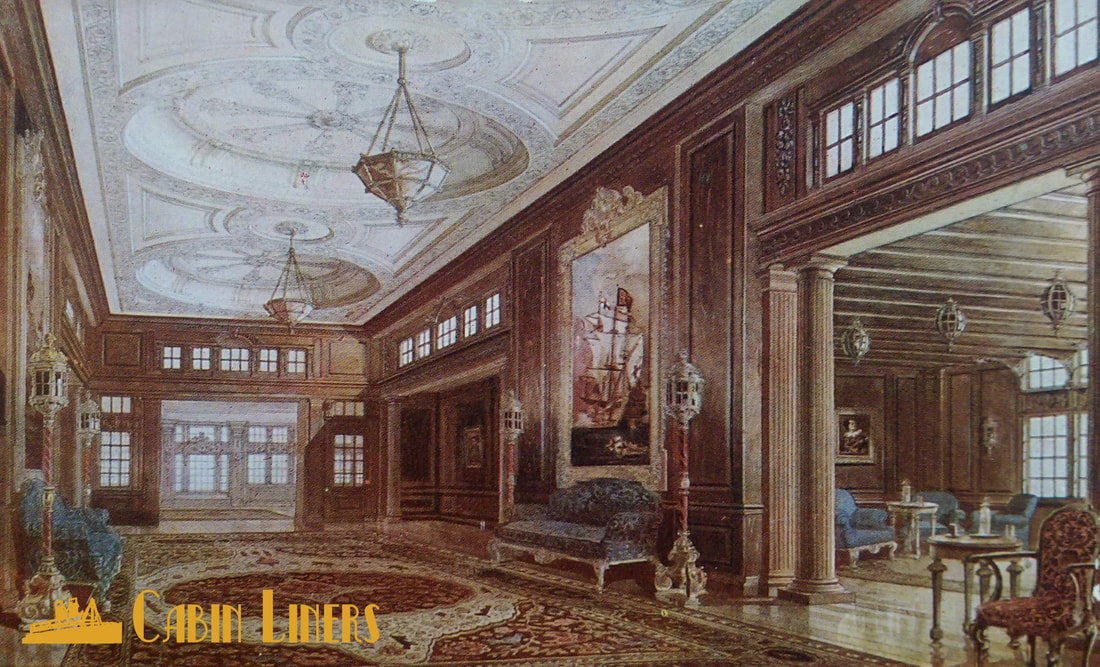
Smoking Room. "R.M.S. Aquitania: Interior Views" brochure. c.1914.
|
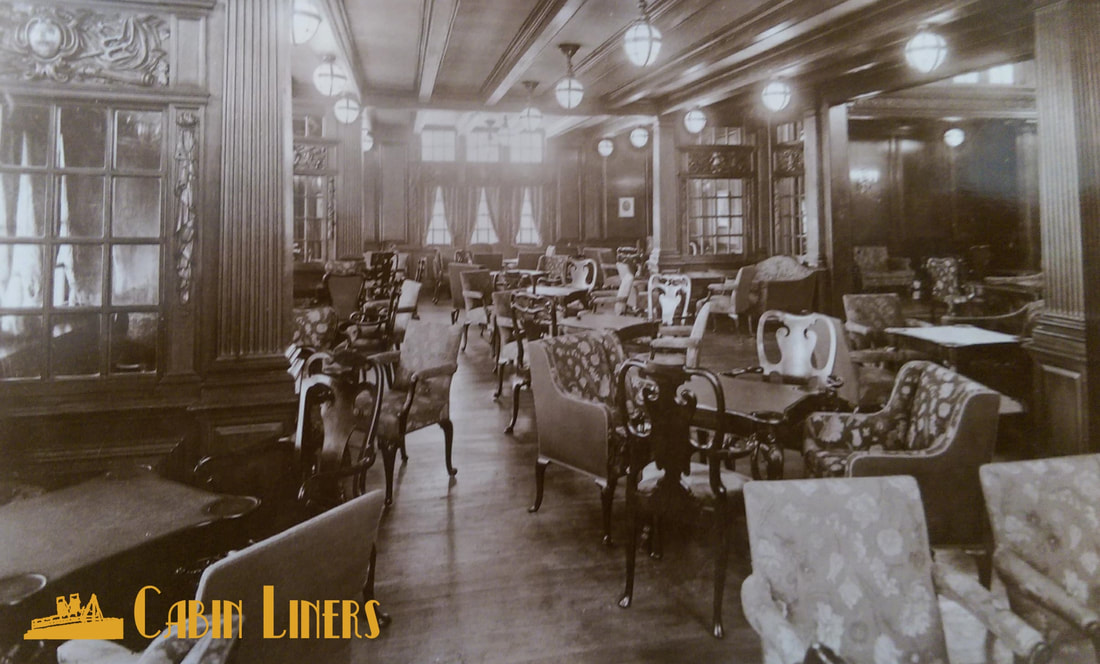
Corner of the Smoking Room. Postcard; c.1929.
|
As seen in the other public apartments aboard Aquitania, reproductions of notable works of art were installed to enhance the atmosphere of the Smoking Room. A nautical theme was evident in subject of these paintings which included such scenes as the 'The Embarkation of St. Ursula' and 'The Embarkation of the Queen of Sheba'. Above the marble fireplace at the forward end of the room hung Kneller's portrait of James VII & II who served as Lord High Admiral both as Duke of York and during his brief reign. The room was extensively furnished with Baroque style armchairs and large settees upholstered in red and blue shades of damask. A large Persian carpet, hand-woven in an intricate design, covered the floor of the central hall. Abundant natural lighting was provided by the tall outer windows in addition to a series of picture windows surrounding the taller raised portion of the central ceiling.
First Class Staterooms
 Sitting room of the Gainsborough suite in its original configuration. "L'Aquitania: La Huitieme Merveille du Monde" brochure; c.1925.
The stateroom accommodations for First Class passengers on Aquitania were amongst the best appointed on the North Atlantic. The finest rooms were the suites located on B-deck, each dedicated in name and decor to distinguished artists of the seventeenth and eighteenth centuries. The largest suites, located immediately forward of the B-deck foyer, were the 'Reynolds' and 'Gainsborough' which embraced three capacious staterooms, two bathrooms, and a private sitting room. In addition, private verandahs had originally been included in their configuration but these were sacrificed in 1926 in favour of creating larger sitting rooms. Further aft on this deck, First Class passengers had the option of a further six such 'Artists' suites in various configurations. A further five smaller 'Parlour' suites were fitted across B-deck and C-deck, each including a private sitting room, private bathroom, and one or two adjoining staterooms. In anticipation of changing passenger expectations, Aquitania had also been fitted with an extensive number of staterooms with private bathroom facilities. Further to the larger suites on B-deck, passengers also have the availability of thirteen further private bathroom suites in addition to a further thirty-one staterooms with private bathrooms across C-deck and D-deck.
 Bedroom of a B-deck suite after later modification. Postcard; c.1929.
The decorative style adopted in the staterooms was comparatively understated yet elegant and refreshing. The walls and ceilings were cleanly finished in white and adorned with elegant Wedgwood detailing. This was perfectly complemented by plush Wilton carpets in shades of blue, green, and grey. The furniture was Georgian in design including large marble washstands and comfortable mahogany bedsteads in place of traditional fitted berths. The walls were hung with skilfully executed reproductions of the works of painters such as Reynolds, Hopper, and Lawrence. All staterooms were fitted with hot and cold running water and modern heating at the control of the occupants. Cunard Line also sought to greatly improve the standards of comfort for passengers in C-deck interior staterooms by introducing an innovative arrangement to ensure lighting and ventilation. This was achieved by adding a raised section to the B-deck promenade thus allowing windows to be fitted to the top of the walls in these 'inside-outside' staterooms on the deck beneath. By the mid-1920s, however, this innovation was no longer required as a large number of these inside accommodations were removed to create larger staterooms. The raised portion of the B-deck promenade was consequently removed by extending the size of the suites on this deck. Together with an updated decorative scheme, this greatly improved the comfort of these already luxurious bedrooms.
First Class Restaurant
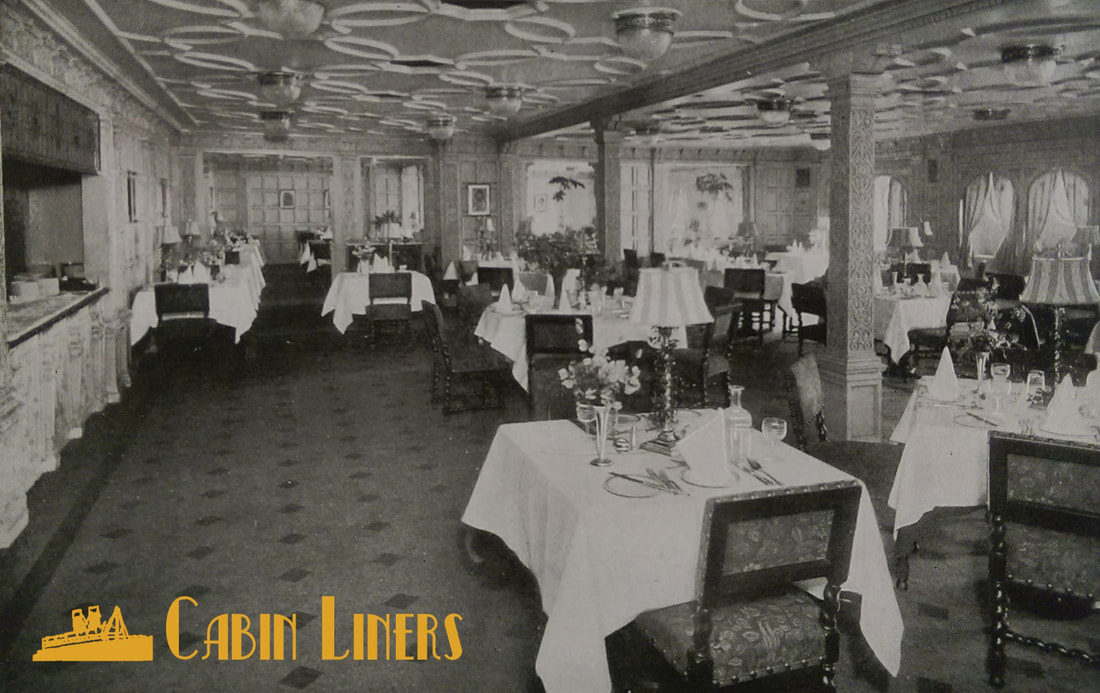
The Restaurant for First Class passengers was located amidships on D-deck with an open-well and musicians' gallery extending upwards onto C-deck. The decor of this vast apartment was in the style of Louis XVI with mahogany wall panelling painted in light grey. The open-well in the centre of the room was supported by an impressive series of Corinthian plaster columns painted in ochre whilst its ceiling was crowned by a large painting entitled 'The Triumpth of Flora' after the rococo artist Lagrenée. Accompanying this were four smaller corner panels showing incense burners, arabesques, and wreaths of fruits and flowers. The space was surrounded by a gallery fitted with ironwork railings adorned with detailing showing the Cunard Line crest and depictions of the Aquitania intertwined the trident of Neptune and similar nautical symbols. The theme of the decoration was enhance by additional artwork throughout the apartment including four great panels showing scenes of eighteenth century French architecture and gardens. A large painting of the Park of the Grand Trianon was hung above the buffet table on the forward wall.

First Class Louis XVI Restaurant. Postcard; c.1914.
An innovation of the Restaurant was the adoption of Á La Carte service as standard in contrast to the fixed-time dining traditionally adopted aboard other liners. Cunard Line had always been sceptical of the adoption of separate restaurants for this purpose. This arrangement therefore allowed passengers the freedom to dine at the time of their choosing whilst maintaining the dignity and tradition of having a single dining saloon to cater for all First Class passengers. The individual table arrangements allowed anything from two to eight passengers to be accommodated at each table as required. The adoption of free-standing dining chairs, carved in French style and upholstered with blue tapestry fabric, further improved passenger comfort. The Restaurant was adjoined by a spacious Reception Room located at the bottom of the Main Staircase. Decorated in a Georgian style and fitted with comfortable rattan furniture, this room provided a space for passengers to gather before and after dinner. It also served as the principal First Class Entrance Foyer and it was therefore the first room seen by most passengers upon boarding the ship.
First Class Grill Room
Grill Room. "L'Aquitania: La Huitieme Merveille du Monde" brochure. c.1925.
|
Complementing the service in the Restaurant, First Class passengers could alternatively decide to dine in the smaller Grill Room, accessed down a corridor at the aft end of the Restaurant itself. This facility was not considered to be a separate restaurant and the same menu was therefore adopted in both rooms. However, the Grill Room provided an altogether more intimate alternative to the main Restaurant. It was particularly designed to appeal to passengers wishing to order meals from the grill which was located adjacent to this room and connected by a corresponding service hatch and buffet table situated against the starboard bulkhead.
|
A Jacobean style was adopted for the decor of this room, inspired by the 'Old Palace' hunting lodge built for James VI & I at Bromley-by-Brow. The walls were fitted with oak-panelling painted in ivory-white, complemented by a low relief plasterwork ceiling. The furniture consisted of faithfully reproduced 'Cromwell' chairs upholstered with petit point tapestry fabric. A balance of style was achieved by the black and white tiles on the floor and the ivory-coloured fabric curtains skillfully embroidered in Elizabethan patterns. The decorative scheme was enhanced by the addition of Delftware ornaments and engraved portraits of seventeenth century figures such as Elizabeth I and Sir Walter Raleigh. Although Aquitania was the longest serving of the great liners of the early twentieth century, the Grill Room would not remain with her until her final days. As passengers numbers recovered from the difficult years of the Great Depression, Cunard Line required space for additional passenger accommodation to meet rising demand. As a result, the Grill Room was removed in 1936 in favour of installing twelve new staterooms.
First Class Leisure Facilities
Aquitania was fitted with modern leisure facilities for the benefit of her First Class passengers. These were located on E-deck at the bottom of the Main Staircase and accessible from the Reception Room on D-deck above. First Class passengers had access to the first swimming pool to be fitted aboard a Cunarder. The apartment of the Swimming Pool was decorated in an Ancient Egyptian theme based specifically on architectural relics held at the British Museum. The walls were panelled in natural teak and topped with a frieze adorned with decorative Egyptian ornamentation. The pool itself was tiled with blue glazed-bricks and Pentelikon marble with a cork flooring surrounding its edge for the comfort and safety of swimmers. A large number of changing cubicles were fitted around the side of the pool itself. These contained hot and colds showers and were hung with curtains embroidered with Egyptian pattens, neatly complementing the tone of the wood panelling.
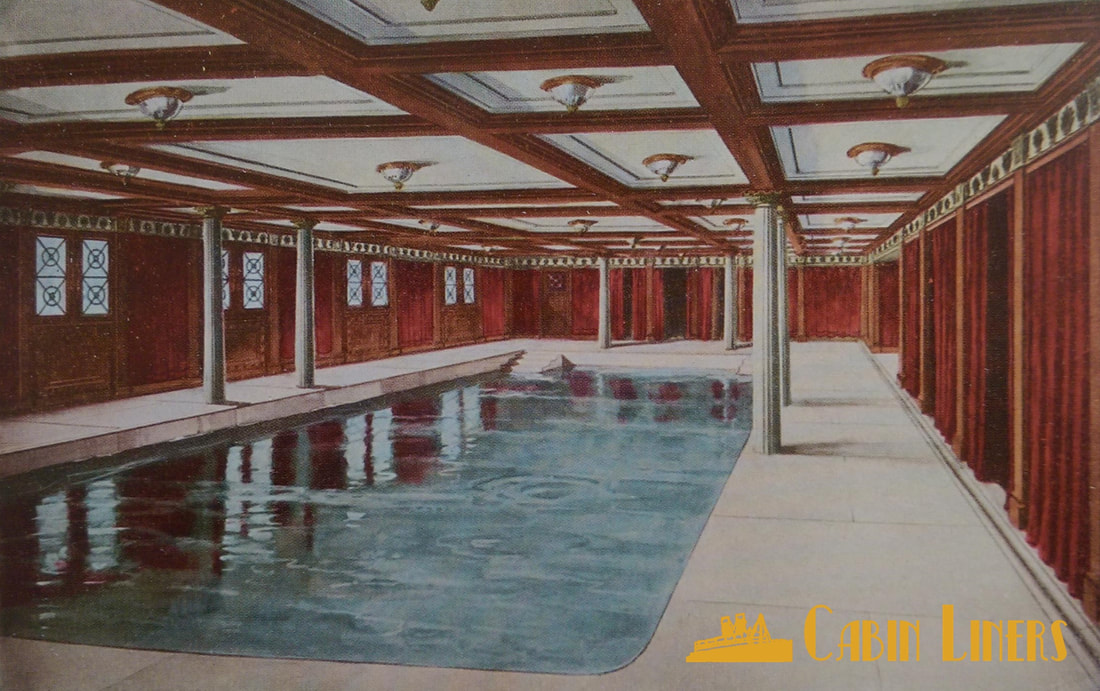
First Class Swimming Baths as shown in an early artist's impression. "R.M.S. Aquitania: Interior Views" brochure; c.1914.
|

A view of the Swimming Baths looking aft towards the Gymnasium. "L'Aquitania: La Huitieme Merveille du Monde" brochure; c.1925.
|
The depth of the pool varied from four-and-a-half to seven feet. Adjacent to the pool and accessible directly from it through three large doorways, Aquitania was also fitted with a well-equipped Gymnasium for passengers' use. Fitted with the most modern fitness equipment available, this room was panelled in dark mahogany with decorative carving matching the decor of the Swimming Baths. These facilities were open at fixed times of the days with distinct opening hours for gentlemen, women, and children. Tickets were purchases from the First Class Enquiries office on D-deck. In additional to the leisure facilities, First Class passengers had access to a traditional Barber's Shop and modem Ladies Hairdresser. These were located alongside the Long Gallery on A-deck.