
First Class on S.S. BelgenlandHer great size, her trim, graceful lines, her thrilling speed, the expert quality of her cuisine and service have all contributed to her international reputation. To cross the Atlantic on the Belgenland is to enjoy the acme of transatlantic luxury. Belgenland was undoubtedly the largest and most finely appointed liner ever operated by the Red Star Line. Her service also represents an interesting point in the development of the 'Cabin Liners'. Built as a modestly large transatlantic liner yet quickly adapted to cater for the growing cruise market, her grand public rooms and well-appointed staterooms accommodated passengers from both key travel markets in the changing days of the late 1920s.
|
First Class Drawing Room
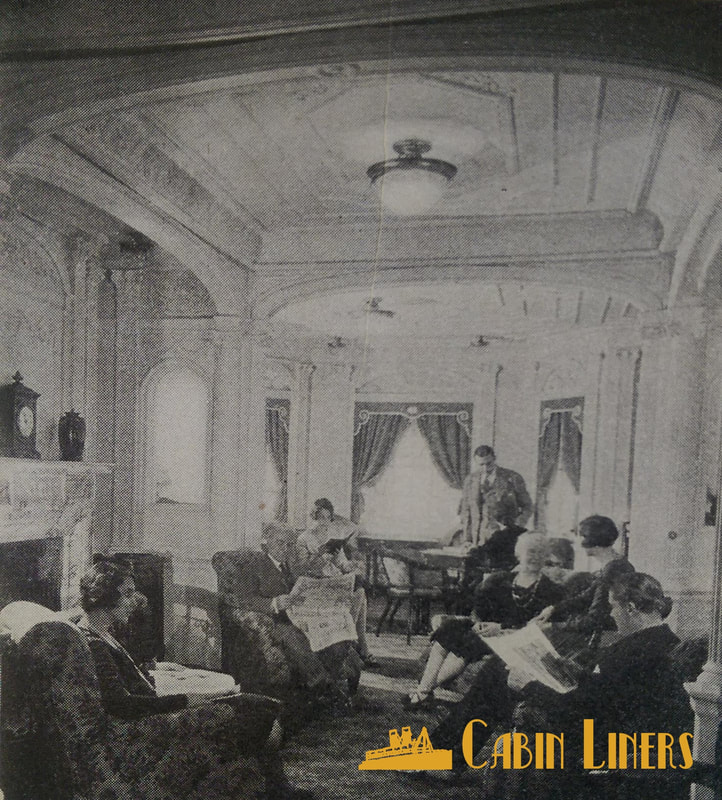
Passengers enjoying the congenial atmosphere of the Drawing Room. "To Europe on the Belgenland: First Class" brochure; c.1926.
|
The principal suite of public apartments for First Class passengers was located on the Upper Promenade Deck. The Drawing Room, located the furthest forward of these rooms, was situated directly forward of the Entrance Hall overlooking the bow. Its location undoubtedly made this room the best place for observation anywhere aboard the ship and it was intended to provide an altogether more quiet and secluded atmosphere than the larger Lounge and Smoking Room. This ambience was aided by intimate arrangement of the space, with a series of plaster columns neatly dividing the room into three distinctive sections. In addition to a series of large picture windows at the front of the room, the two sections on either side contained capacious bay windows, providing intimate sitting spaces with sweeping views out over the promenade outside. The Drawing Room was decorated in a late Georgian style with intricately detailed white plasterwork complemented by the floral patterns of the rugs and armchairs. In the centre of the aft wall, a large archway framed a decorative niche fitted with a marble fireplace.
|
First Class Lounge
Located amidships on the Upper Promenade Deck, the Lounge was accessed from the Entrance Hall down a long corridor on the starboard side. This charming apartment served as the main social space for First Class passengers. The decorative scheme adopted in this room was Baronial with stylistic features reminiscent of the Revival styles popular in Scottish and English architecture during the Victorian era. The walls were panelled in oak adorned with highly decorative carved detailing. The panels were fitted with decorative sconces and small portraits, the most notable set being Albert I and Elizabeth of Bavaria, King and Queen of the Belgians. The most impressive feature of this apartment was the substantial fireplace on the forward wall. This was fitted with a marble surround set within an intricately carved oak mantelpiece. A pair of large curved settees and a padded guard rail were fitted before the fireplace, making it perhaps the most popular spot for sitting within the Lounge.
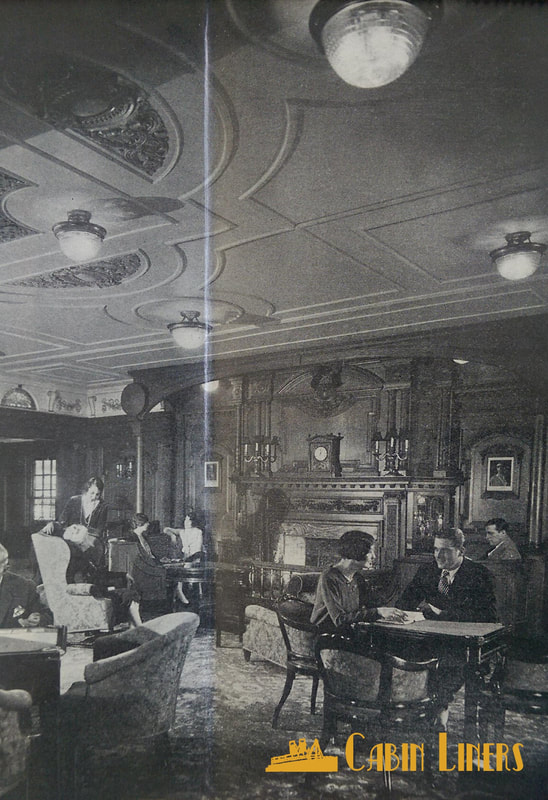
An afternoon in the 'Great Lounge'. "To Europe on the Belgenland: First Class" brochure; c.1926.
|
In the great lounge, is found the magnificence and splendour reminiscent of baronial Europe ... the genuine fireplace, with its grill and its glowing embers, lends a subtle charm to the room and calls to mind the England which Scott knew so well. Red Star Line Brochure; "To Europe on the Belgenland: First class"; circa 1926A plasterwork frieze adorned with floral mouldings and stained-glass lunette windows surrounded the top of the room. This was neatly complemented by the low relief ceiling fitted with large decorative panels in seventeenth century designs. On either side of the room, two large bay windows separated by internal wooden walls nearly divided the room into more secluded spaces to sit and observe the deck outside. The room was extensively furnished with large settees and armchairs in floral patterned upholstery together with club chairs arranged intimately around small card tables. The floor was covered with thick floral carpets. Directly across from the fireplace, a tall glass-fronted bookcase supplied passengers with an extensive collection of classic works, modern novels, and current periodicals. Cards and other games could also be borrowed by passengers.
|
First Class Smoking Room
|
The Smoking Room for First Class passengers was the largest of the public rooms located on the Upper Promenade Deck. Arranged in a U-shape around the farthest aft ventilator shaft, the room comprised a large central section dividing into two more intimate aisles moving aft. The most noticeable feature of the Smoking Room was the vast vaulted glass ceiling crowning the central section. Fitted with plain glass panels within lightly decorated edging, this window flooded the room with natural light from the Sun Deck, neatly balancing out the darker tones of the decor. This was further enhanced by large picture windows around the sides of the room, providing views out onto the promenade deck outside. The style of the decoration was late seventeenth century Baroque, comprising tinted cedar panelling adorned with elegantly carved lime-wood detailing of fruits and foliage in the Dutch style. The walls were hung with large paintings by the Flemish artist Cassiers, showing scenes in famous Belgian cities. Tall Ionic pillars separated the various sections of the space. An atmosphere like that of a fashionable gentlemen's club ashore was evident in this handsome room. The furniture consisted of wide wing-back chairs in green and brown leather together with large fitted couches, numerous card tables, and ornate standing ashtrays.
|
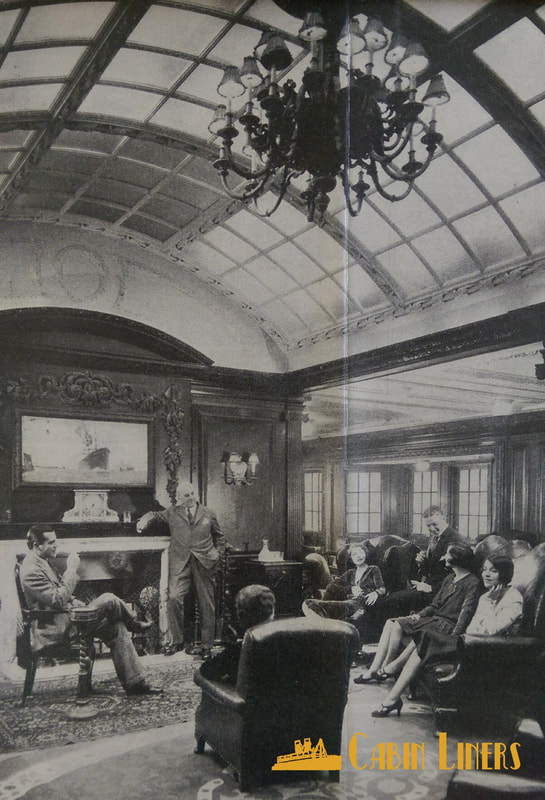
Passengers smoking in the 'central vault' of the Smoking Room. "To Europe on the Belgenland: First Class" brochure; c.1926.
|
The decor represented the traditional use of smoking rooms as gentleman's only abodes. However, this principle of separation of public spaces gradually fell out of fashion by the mid-1920s. As one of the first great fashionable liners with dedication to cruising, Belgenland would represent one of the first liners where ladies enjoyed the Smoking Room on equal terms. The room was serviced by a large connecting bar and pantry.
First Class Verandah Café
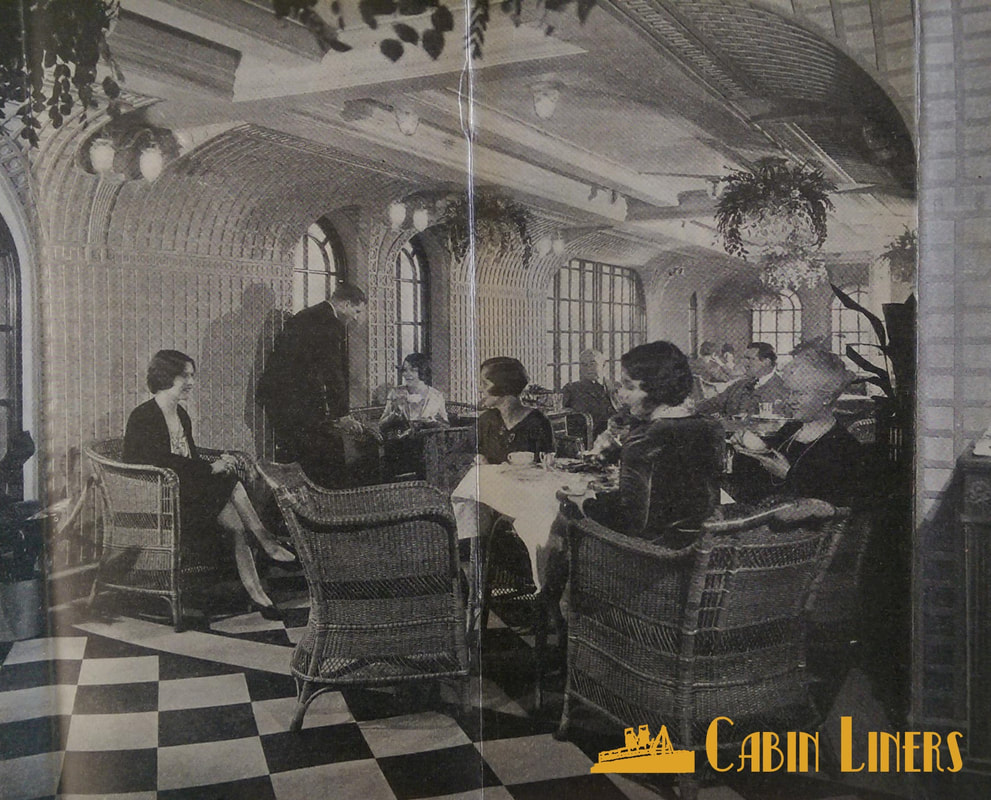
Vernadah Café. "To Europe on the Belgenland: First Class" brochure; c.1926.
|
At the rear of the Upper Promenade Deck, First Class passengers had access to a cheerful Verandah Café looking out towards the stern of the liner. The Verandah was connected to the adjoining Smoking Room by two sets of revolving doors, one on the port and starboard side respectively. This room extended the full width of the deckhouse with large arched windows providing stunning views of the deck in addition to plentiful natural light. Designed to appear like a garden terrace, the walls were covered with fitted green trellises to hold climbing plants together with additional planters hanging from the ceiling. The flooring consisted of black and white linoleum tiling and the room was furnished with large cane furniture arranged around spacious tables.
|
First Class Reception Room
In addition to the principal public rooms on the Upper Promenade Deck, Belgenland's First Class accommodation also included a spacious Reception Room adjoining the Dining Saloon on C-deck. Sometimes referred to as the 'Ballroom' or 'Palm Court', this impressive space had numerous uses during any voyage. This was the first room that most First Class passengers encountered aboard the ship, having boarded through one of the Vestibules on either side of the room. During the day, it served as an additional lounging space where afternoon tea could be taken. Its primary use was as the ante-room to the Dining Saloon where passengers gathered before meals and withdrew after dinner for dancing and entertainment most evenings. A spacious dance-floor was fitted for this purpose.

Reception Room. "To Europe on the Belgenland: First Class" brochure; c.1926.
The most impressive feature of the room was the vast crystal screen which divided it from the Dining Saloon, providing a sweeping view extending three-hundred-feet between the two apartments. The Reception Room had a light and airy atmosphere created by its decor of white Georgian style plasterwork. Natural light was provided by large portholes which were neatly disguised by Luxfer stained-glass windows, similar to the type fitted to the White Star Line's Olympic-class liners. The room was furnished with large cane furniture and enhanced by the inclusion of tall potted ferns and low planters throughout. A Steinway grand piano was installed in one corner of the room.
First Class Staterooms
Belgenland offered an extensive number of staterooms and suites in various configurations. The most extensive number of suites was located on A-deck in a layout which allowed for different room arrangements to suit the varying needs of passengers. Eight suites in total were located on this deck, each comprising a spacious private sitting room and private bathroom in addition to one or two large staterooms. Interconnecting doors to neighbouring cabins allowed suites to extend to up to three staterooms if necessary, including an additional private bathroom. An addition three suites in different arrangements were available on B-deck. These including one two-bedroom suite with private sitting room and two private bathrooms. The other two suites encompassed only one bedroom, although these were fitted with far larger sitting rooms and a capacious trunk room, therefore providing luxurious options for couples and free-spending single passengers.


Belgenland staterooms were designed not merely for comfort and rest ... they were tastefully and distinctively decorated to be your private shipboard home during a radiant sea holiday.
"To Europe on the Belgenland; First Class" brochure; c.1926
By the mid-1920s, private bathroom facilities were increasingly expected as a standard feature for First Class passengers. Despite being designed in the pre-war era, Belgenland had fortunately been fitted a more extensive number of private bathrooms than would have been considered necessary for her time. In addition to the various suite arrangements, a further thirty-five First Class staterooms had access to adjoining bathrooms and water-closets. All staterooms were fitted with hot and cold running water, electric heaters, and modern ventilation systems. The decor was light and elegant with white panelled walls, mahogany furniture, and floral patterned rugs and upholstery. Many of the suite staterooms were enhanced by decorative frieze designs surrounding their ceilings in addition to numerous wall paintings, large armchairs, and fitted electric fireplaces with marble surrounds.
First Class Dining Saloon
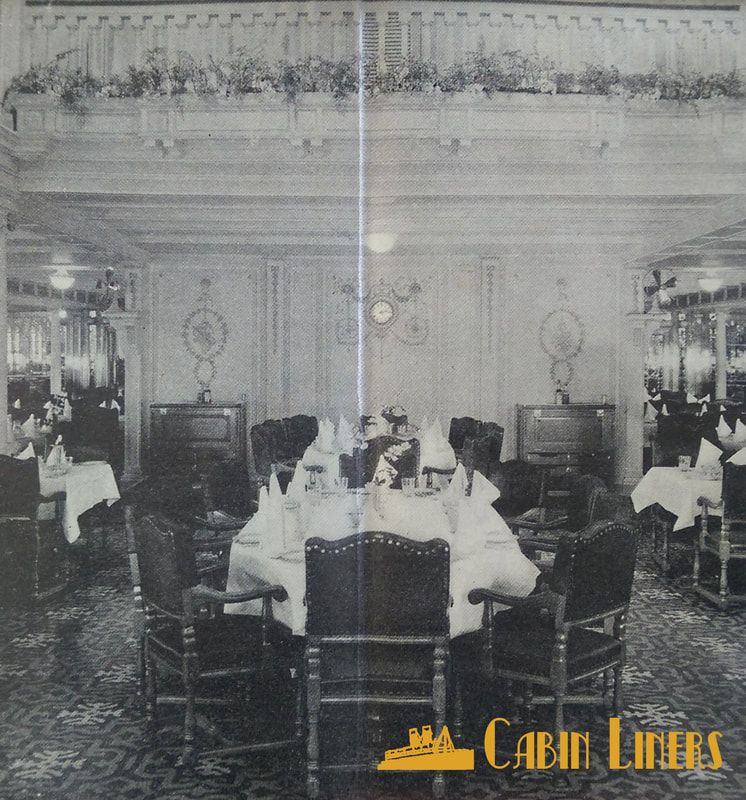
The open-well section of the Dining Saloon showing the Musicians' Gallery. "To Europe on the Belgenland: First Class" brochure; c.1926.
|
The largest room aboard Belgenland was the First Class dining saloon, located on C-deck directly aft of the spacious Reception Room. In the middle of the room was a large open-well extending upwards onto B-deck which was fitted with a musicians' gallery. The apartment was impressive in its size and decoration. In a style continuous with the adjoining Reception Room, the Dining Saloon was decorated in a late-Eighteenth century style with ivory-white walls adorned with decorative pilasters and low-relief plaster mouldings.
The Dining Saloon is a masterpiece of design and appointment ... magnificent in proportion ... dignified in decoration ... and smartly cosmopolitan in atmosphere. "To Europe on the Belgenland; First Class" brochure; c.1926
|
The space was divided into distinctive sections by a series of Ionic columns. The lighter decor was neatly balanced by the more colourful tones of the green leather dining chairs and the linoleum flooring in shades of red, blue, and yellow. The portholes were hidden by luxfer glass panels lit from behind, adding to the elegant feel of the room and enhancing the provision of light during the evenings. The tables could be arranged in even numbered seating for anything between two and twenty-two people.
First Class Leisure Facilities


Undertaking extended world cruises as well as her regular transatlantic route, Belgenland was one of the first large vessels to enter service during the expanding 'leisure class' era. This was reflected in the extensive leisure facilities offered aboard for her First Class passengers. Indoor leisure facilities included a Swimming Pool and Turkish Bath facilities. These were located in a large apartment on E-deck, accessed down a small staircase from the corridor on D-deck above. Belgenland was also fitted with two outdoor Swimming Pools on the aft end of A-deck which proved highly popular during her world cruises. Further facilities were located on the open-air Sports Deck including a large fully-equipped Gymnasium and a Children's Playroom. Outdoor activities included deck Tennis Courts, deck games, golf driving, and trap shooting. During summer cruises to warmer climates, a section of A-deck adjacent to the Swimming Pools was transformed into a real sand lido beech complete with deck chairs, parasols, and a modern 'American Bar'. First Class passengers also had access to a Barbers' Shop, Ladies Hairdressers, and a Manicurist.