
Cabin Class on R.M.S. Celtic & R.M.S. CedricThe Cedric and Celtic (21,000 tons) of the White Star Line. They are noted for their steadfastness and the beauty of their interiors. With extensive decks, spacious public rooms, and comfortable staterooms, they retain all the features which made them popular with first-class passengers. Celtic and Cedric carried the new 'Cabin Class' passengers from 1926. This alteration was to ensure their popularity and profitability against the competition of the larger express liners. This new class promised solid standards of comfort at more modest prices than modern First Class travel could offer. Having undergone extensive refurbishments after the First World War, Cabin Class passengers enjoyed accommodations which were greatly improved upon the standards which even First Class passengers had previously enjoyed.
|
Cabin Class Lounge

The refurbished Cabin Class Lounge. "White Star Line: Cabin Bekvemmeligheter" Brochure; c.1929.
|
A large Lounge for Cabin Class passengers was located at the fore of the main deckhouse on Deck 'A' with large windows providing natural light from the boat deck promenade. This apartment was handsomely decorated in carved oak paneling with stained glass panels decorating the windows. Looking down over the room was an intricately carved plasterwork ceiling with a large skylight consisting of four large vaulted panes. The skylight and walls were framed by a decorative frieze in the classical style. Originally furnished with large upholstered settees and fixed writing desks, the Lounge was later fitted with smaller tables and plush armchairs. The walls were also painted in lighter pastel tones and enhanced by the inclusion of large 'art deco' style light fittings.
|
This room originally had a significantly smaller floor space aboard Celtic. This was because of the large skylight above the Dining Saloon three decks below which extending right through into the centre of the room. This had been altered for the design of Cedric resulting in a larger lounge space. Celtic's dome was later lowered in height to accommodate the new Drawing Room on Deck 'B' thus also expanding the space within the lounge in line with her younger sister. This room was perhaps the most popular on board for conversing, playing cards, and the taking of refreshments. Serving also as a library, books and periodicals could be loaned from its large bookcase which was decorated with marquetry panels and inlaid sea-shells on its doors.
Cabin Class Smoking Room

The refurbished Cabin Class Smoking Room. "Boston-New York Dienst, Kajuits-Klasse Accommodatie, White Star Line" brochure; c.1929.
|
The Smoking Room for Cabin Class passengers could be found along an airy corridor aft of the main staircase. The decoration in this room consisted of rich mahogany panelling and heavy damask wallpaper with an imitation leather effect. The seating had originally been arranged in intimate booths reminiscent of an old English public house, each with a large marble topped table. Similarly to the Lounge, these were later replaced by large armchairs upholstered in either leather or geometrical print fabrics. These were placed around small tables to create a more open and inviting arrangement.
|
A nautical theme was evident throughout the decor, from the decorative frieze around the ceiling to the scenes depicted in the stained-glass panels on double-sized windows. The colour scheme was one of red, brown, and dark grey. A domed skylight provided additional illumination from above. The walls were later fitted with large arched mirrors with 'art deco' motifs, both modernizing the room's appearance and enhancing the sense of space compared with its darker Edwardian style. Drinks could be ordered from the communicating bar which served until 10:30pm.
Cabin Class Verandah CaféCeltic and Cedric underwent post-war refurbishments in 1921. Upon re-entered service, their passenger accommodations had been improved by the addition of a new Verandah located at the aft end of the Promenade on Deck 'A'. This bright and airy apartment allowed passengers to enjoy refreshment in a sheltered location whilst still enjoying open views of the deck and the sea. The new Verandah Café was decorated in a bright but plain style, painted in white and furnished with large wicker seating. The room was serviced by a small dedicated bar and pantry on the starboard side. A staircase connected the Verandah with the covered deck below, allowing promenading passengers to enter the room without exposure to the elements.
|

Verandah. "Famous Cabin Liners" Brochure; 1928.
|
Cabin Class Drawing Room
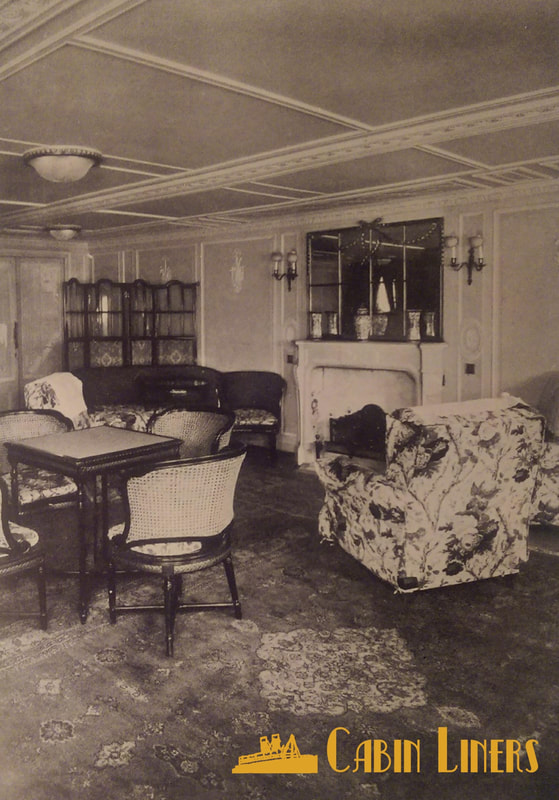
Cabin Class Drawing Room. "Famous Cabin Liners" Brochure; 1928.
|
In addition to the public rooms available on the deck above, Cabin Class passengers could retreat to the more secluded atmosphere of the Drawing Room, located in the fore-starboard corner of Deck 'B'. The Drawing Room was a later addition to the liner, added in 1921 at the expense of seven staterooms. Sometimes designated as the 'Reading & Writing Room', the decoration of this apartment included light wall paneling in soft colour tones. Small windows draped with floral curtains allowed views both forward towards the bow and starboard towards the promenade deck.
Delicate in colouring and beautficully panelled, this handsome room, intended principally for ladies' use, has a charm which is enhanced by the delightful furnishings. White Star Line Brochure; "the big four" from liverpool; circa 1925 |
The Drawing Room was furnished with large armchairs with floral patterned fabric covers, small card tables accompanied by wicker easy chairs, and thick floral rugs. A marble fireplace was installed with an electric heater, creating a cosy atmosphere. The overall impression of the room was that of a homely sitting room where passengers could peacefully while away the afternoon with a book or engage in light conversation with their fellow travelers.
Cabin Class Staterooms
|
The most spacious Cabin Class staterooms were located on Deck 'B' and Deck 'C'. Staterooms were attractively decorated in white paneling with large washstands and broad windows overlooking the promenade decks. Brass bedsteads, modern electric lighting, steward call buzzers, and small electric heaters at the control of the occupants were included in every stateroom. All staterooms in Cabin Class accommodated between one and three passengers and a number were fitted with Pullman folding berths. When the two sisters entered service, private bathroom facilities were considered a luxury and only fitted the four (Celtic) / eight (Cedric) largest suites on the upper decks. These suites encompassed two or three staterooms, those with the third stateroom allowing for an additional bedroom or private sitting room as desired. In response to the growing demands of passenger comfort, the White Star Line installed a further four suites and ten further private bathrooms attached to individual staterooms during the 1921 refurbishments.
|

R.M.S. Cedric single berth stateroom. "White Star Line: Cabin Accommodation" brochure; c.1930.
|
Cabin Class staterooms on Deck 'C' were mostly contained within the main deck-house extending fore and aft of the main staircase and Enquiries Office. This deck included four suites comprising three staterooms and a private bathroom. A further twenty-one spacious three-berth staterooms and eleven smaller single-berth staterooms were also installed. This number was reduced in 1921 to accommodate additional private bathroom facilities. Forward of the main deck-house, a separate smaller deck-house accommodated twelve smaller three-berth staterooms. This accommodation could only be accessed either from the deck or using a staircase from the corridor on the deck below.
Cabin Class Dining Saloon
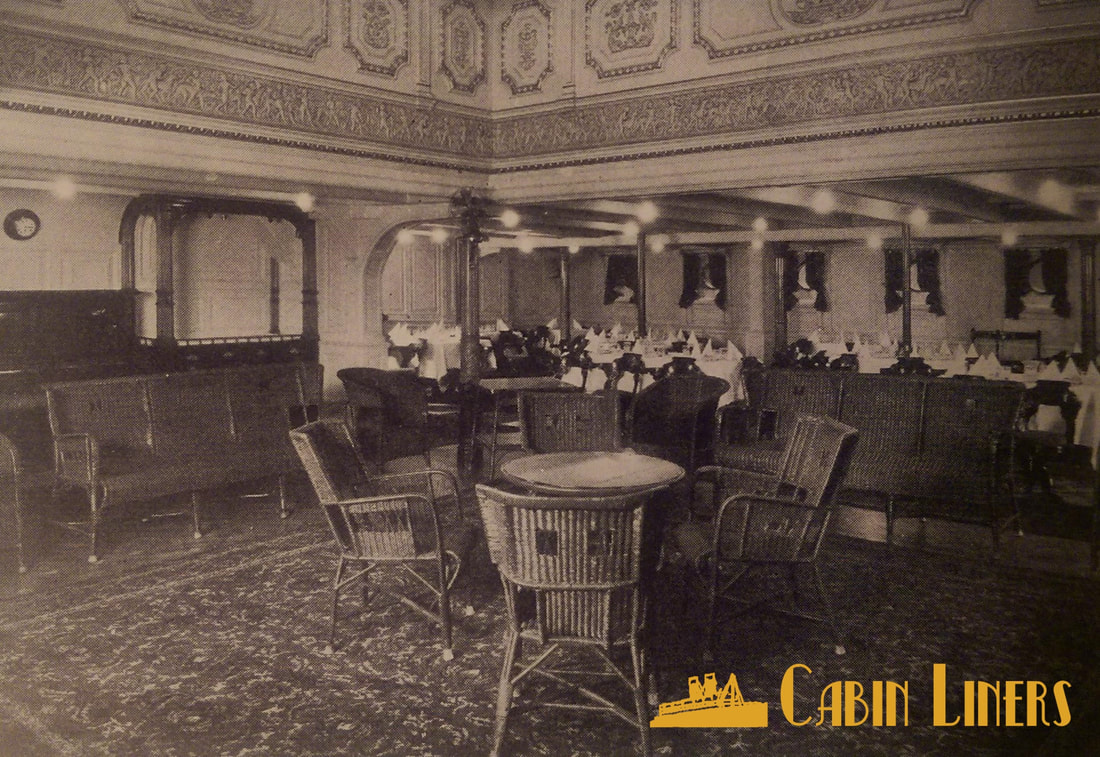
Cabin Class Dining Saloon. "Famous Cabin Liners" Brochure; 1928.
|
Dining for Cabin Class passengers took place in the large Dining Saloon located at the bottom of the main staircase. Extending the entire width of the vessel, this room was magnificent in its proportions and decoration. This room had originally been laid out with long galley tables with fixed swivvel seating. Dining arrangements were later improved by replacing these long tables with smaller tables seating two, four, or six passengers. In 1928-29, further improvements were made by replacing the fixed seating with individual dining chairs upholstered in leather, neatly matching the original decorative scheme whilst adding a more modern feel.
|
A dance floor was also installed in the middle of the room with some tables being removed and replaced by modern cane furniture. This gave the room the appearance of a modern social hall and it was popularly used for after-dinner dancing. The walls were decorated in richly inlaid oak panelling which had been later painted in ivory white enamel to give the room a more contemporary appearance. Located at the fore end of the apartment was a large wooden niche fitted with a piano. This was used for divine services and later also for dancing. Celtic's saloon was originally crowned by a spectacular glass dome. This provided the room with further decoration as well as bright illumination in the evenings. The dome was later lowered and simplified to accommodate improvements to the public rooms on the upper decks. Cedric featured a simpler dome composed of four vaulted panes of frosted glass.