Cabin Class on S.S. LaplandFew ships have greater popularity than the Lapland (18,565 tons). Her admirers are numbered by the thousands. Her cabin accommodations are truly remarkable, and are most club-like and attractive. S.S. Lapland was one of the largest and finest vessels built for the Red Star Line. From 1926, her comfortable First Class accommodations were transferred to Cabin Class passengers, offering this new category of traveler exclusive access to her elegant public rooms, enclosed decks, and spacious staterooms.
|
Cabin Class Lounge
|
The Lounge for Cabin Class passengers was a spacious apartment located at the forward end of the Upper Promenade Deck. The deckhouse extended almost the full width of the ship, being wrapped-around by the narrower open section of the promenade deck. Abundant natural light was provided by double-sized picture windows extending around three sides of the room. A sense of height was created by the raised central section of the ceiling which was fitted with a further series of lunette windows. The windows were fitted with stained glass completed in elegant yet understated designs. The room was decorated in the dignified early Georgian style. The lower portion of the room was panelled in dark mahogany whilst the upper section was panelled in oak relieved with handsome carvings. The floor was laid with oak parquetry whilst the ceiling was completely in white plaster with simple relief mouldings. Directly opposite the fireplace was a large three-sided bookcase housing a stock of books and periodicals available for passengers to borrow during the voyage.
|

The Lounge fireplace. "Famous Cabin Liners" Brochure; 1928.
|
"The passenger will have the same luxury and comfort as in their own home. There are card tables set around with comfortable chairs, and ladies will find numerous tables provided to hold their work and work baskets. Here, too, in quiet corners are small writing tables with every accessory."
Red Star Line Brochure; "Gates Cruise around South America: S.S. Lapland"; 1915
A large Inglenook with an open fireplace was fitted within the aft end of the room. Fitted with curved settees and crowned by an impressive archway which made full use of the lofty height of the room, this provided one of the most attractive places to sit aboard the ship. The Lounge was furnished with delicately carved mahogany furniture upholstered in blue moquette. Four spacious seating booths with fitted settees were incorporated into the space beneath the forward windows whilst the remainder of the space was furnished with large armchairs, writing desks, and card tables surrounded by club-chairs.
Cabin Class Library
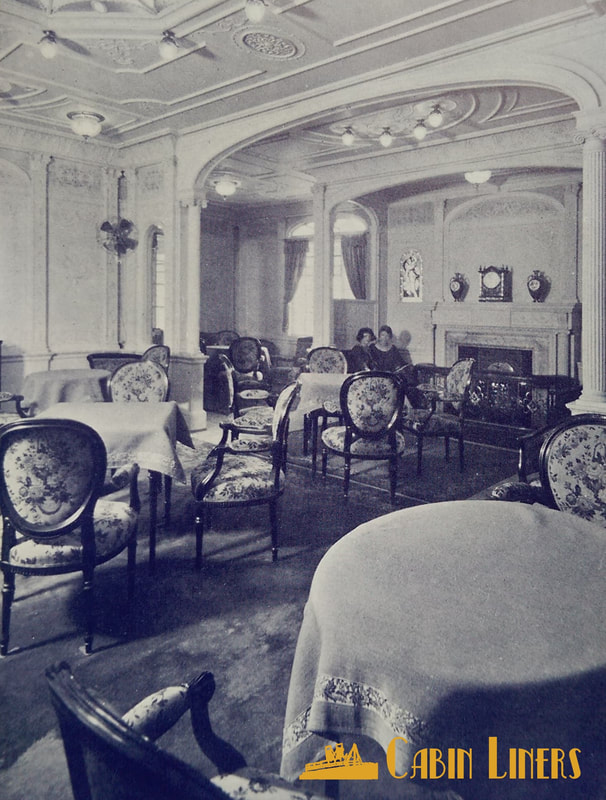
The Library in its original configuration before the addition of the Long Gallery section. "Famous Cabin Liners" Brochure; 1928.
|
The Cabin Class Library was situated amidships on the Upper Promenade Deck and accessed from a corridor which connected the Lounge and Smoking Room. Alternatively named the Reading Room or Ladies' Room, this elegant apartment was designed to provide a more quiet and secluded space than the larger public rooms. The Library was completed in white with pastel accents in the style of the Adams brothers. Its walls were artistically decorated with scrollwork and its ceiling was adorned with intricate plasterwork detailing. A flush octagonal skylight supplied an additional source of natural light during the day whilst crystal pendant lighting illuminated the room by night. On the starboard wall, directly facing the doorway, the room was fitted with a large Inglenook framing an open fireplace with a marble surround. The wall above the mantelpiece was fitted with a pair of stained glass decorative panels, adding a note of colour to the cosy atmosphere of the Inglenook seating area. The Library was constructed in a T-shaped arrangement with a large central section connected to a two smaller alcoves on either side of the fireplace. These alcoves were fitted with near ceiling-height windows providing wide views of the deck.
|
By 1932, Red Star Line had taken the decision to substantially expand the room by lengthening these two alcove sections across a large portion of the promenade to form a Long Gallery. The Long Gallery now connected both forward to the Staircase and Lounge and aft to the Smoking Room, allowing passengers to walk between them by using the Library as a connecting passageway. This required the sacrifice of the original Inglenook feature but the overall style decorative style of the room was preserved during the changes. The Library was furnished with large settees and Louis XVI chairs of inlaid Cuba mahogany upholstered in floral fabrics.
Cabin Class Smoking Room
|
A long corridor connected the Lounge and staircase with the Smoking Room further aft on the Upper Promenade Deck. This room was panelled in dark oak in the Dutch style. The wood panelling was fitted with a series of paintings depicting well-known locations in Belgium, Great Britain, and the United States. The most striking feature of this apartment was its impressive wagon-headed glass dome which crowned the main section of the room. Structured into interlinking panes of varying shapes and sizes, the dome was fitted with a series of impressive stained glass windows depicting the twelve signs of the Zodiac. The base of its well was surrounded by an elegant classical frieze fitted with four three-bulb pendant light fixtures. The dome itself was encased within an outer skylight, protecting it from the elements and allowing it to be illuminated from behind at night. Additional lighting was supplied by a plentiful supply of smaller pendant light fixtures throughout the room. The room was arranged into a U-shaped consisting of a main section beneath the glass dome leading to two long-corridor sections on either side of the room which stretched aft in connection with the Verandah Café.
|

A scene in the Smoking Room. "Famous Cabin Liners" brochure; 1928.
|
The decor of the Smoking Room was designed to create the impression of a public house ashore. Its furnishings included 14 seating booths upholstered in green leather, each fitted with a card table neatly designed to hold drinks on a lower section beneath the table top. The rest of the room was supplied with fixed swivel-chairs upholstered in the same fashion. Two fitted writing desks were also supplied, presumably to accommodate gentlemen who wished to write letters without intruding upon the principally feminine space of the Library. This culture of gender separation between spaces became less significant by the late 1920s. Drink orders from the Smoking Room were supplied by a communicating bar located in the port side corridor.
Cabin Class Verandah Café
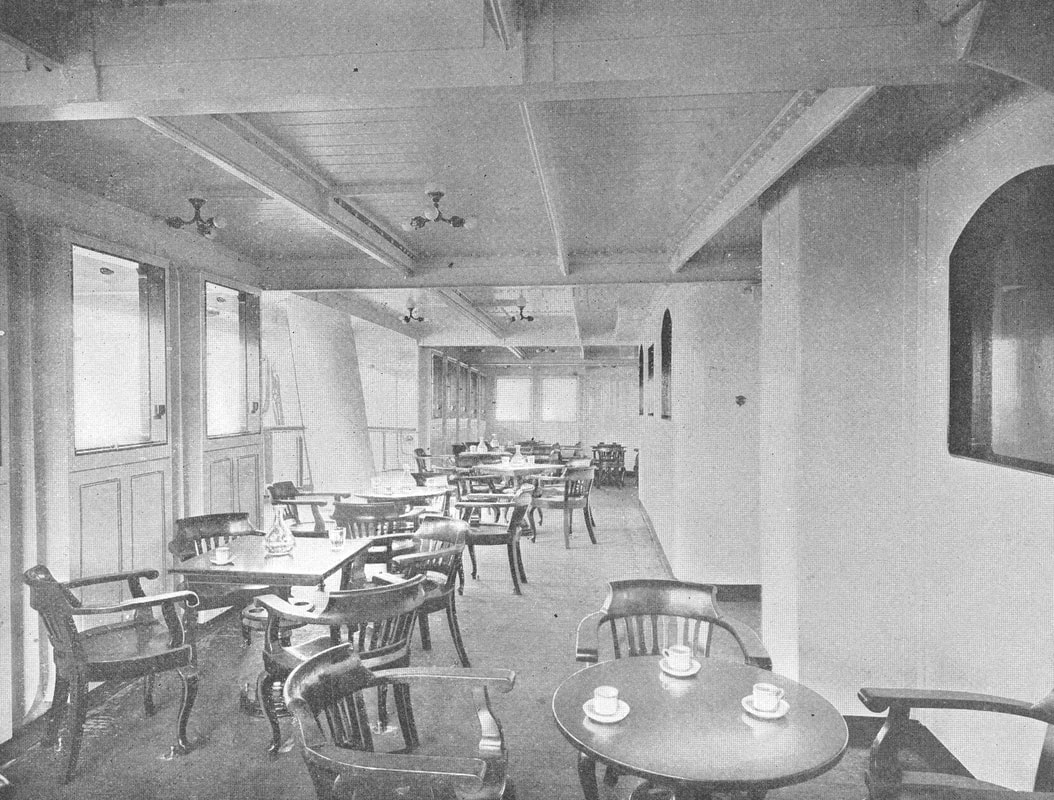
Verandah Café. "Red Star Line: New Twin-Screw Streamer Lapland" brochure; 1909. [Image in Public Domain. Source: Wikicommons]
|
The Verandah Café was located to the rear of the Smoking Room at the aft end of the Upper Promenade Deck overlooking the Sports Deck. This feature was an innovative addition when Lapland first entered service in 1909, with Red Star Line advertising emphasising the appeal of being able to enjoy light refreshments in the sea air whilst being sheltered from the elements. Fresh air was supplied by a series of large sliding windows which could easily be adjusted according to the particular climate. In its original layout, the central section of the aft bulkhead was completely open to the rear deck. This was later boxed in with swing doors added to provide additional shelter. The room was furnished plainly with plain white enamel walls and dark teakwood furniture.
|
Cabin Class Staterooms

Stateroom B-51 or similar. "Famous Cabin Liners" brochure; 1928.
|
Cabin Class Staterooms were available across A, B, and C-decks. Lapland offered staterooms in a variety of sizes and configurations. The largest of Lapland's upper-deck staterooms were also among the largest available aboard any Cabin Liner. From her original design, she had also been fitted with a generous number of private bathrooms in comparison to her size. The highest priced staterooms aboard were the two sitting room suites on A-deck, each encompassing one two-berth stateroom attached to a private sitting room and private bathroom. Six additional staterooms on this deck were equipped with private bathroom facilities and a further eight could be combined into suites encompassing a private bathroom attached to either one or two staterooms as required. Ten private bathrooms were also attached to staterooms on C-deck which could be conveniently arranged into a number of individual or suite configurations. After 1928, further improvements to C-deck accommodations were made by knocking together blocks of six staterooms to create fewer but larger staterooms arranged in blocks of three or four.
|
|
After the introduction of Cabin Class, Lapland's staterooms were refurbished to keep pace with modern tastes and expectations. The original plain white panelled walls were enhanced with painted panels or decorative wallpapers. Traditional washstands were placed by modern sinks with hot and cold running water. All Cabin Class staterooms were fitted with modern heating and ventilation systems fully at their occupants' control. The addition of large rugs, fresh flowers, wicker armchairs, and improved soft furnishings in modern styles further modernised their appearance. Original fitted berths were also replaced with modern bedsteads. Whilst a number of staterooms had been fitted with Pullman berths, these had been designed to be removed entirely if they were not needed thereby improving the space and appearance of these rooms. Lapland was also remarkable for offering an unusually high number of single-berth staterooms. Although many of these were sacrificed in the C-deck refurbishments to accommodate a number of large rooms, twenty-one rooms specifically configured for single passengers remained after these modifications.
|

Stateroom B-56 or similar. "Famous Cabin Liners" brochure; 1928.
|
Cabin Class Dining Saloon
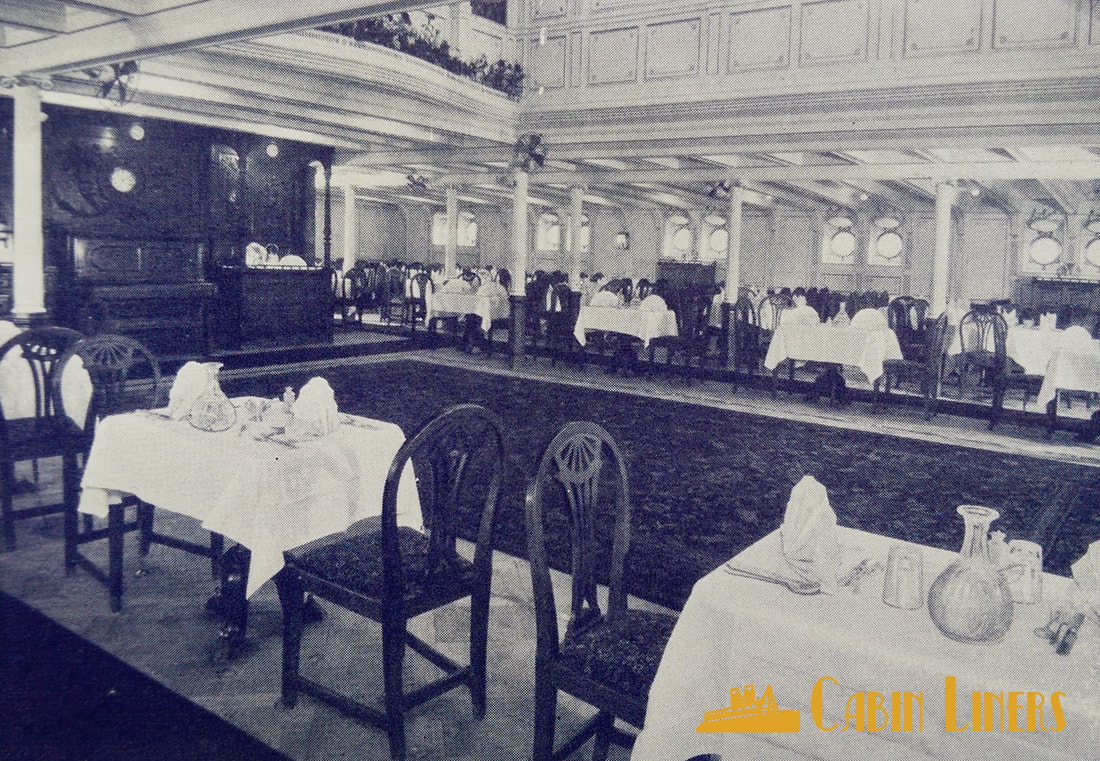
Dining Saloon. "Famous Cabin Liners" brochure; 1928.
|
The Dining Saloon was located on D-deck, the lowest level of Cabin Class accommodations. As the largest apartment aboard the ship, the room stretched the full width of the hull at 70ft across. The room was decorated with carved white panelling adorned old gold detailing, with the dado section finished in mahogany. The central section of the ceiling was raised upwards into C-deck to create an open well. This well accommodated a musicians' gallery at the aft end, allowing an orchestra to play during meals. At the same end of room was an intricately carved oak niche fitted with an upright piano for use during divine service.
|
The room had originally been furnished with long galley tables accompanied by swivel seating attached by the floor. After Lapland's conversion to a 'Cabin Liner', these were replaced with smaller dining tables seating between two and eight diners. The seating was improved by the introduction of free-standing armchairs. The central section of the floor was also fitted with a dance-floor to provide a space for evening's entertainment. With the addition of paired portholes and pendant lighting, the decorative scheme created a bright and spacious apartment. Before and after-dinner, Cabin Class passengers could gather in the large Foyer on B-deck which acted as a Reception Room. This room was panelled in oak and decorated with Delft style paintings. Both rooms communicated with an elevator connecting every deck of Cabin Class accommodation.
Cabin Class Leisure Facilities
Although as a smaller vessel Lapland's entertainments were more limited that aboard larger vessels in the I.M.M. fleets, she did provide a number of leisure facilities for the use of her Cabin Class passengers. Cabin Class passengers had access to a barber's shop, hairdressing salon, and photographer's darkroom. By 1932, Red Star Line had made efforts to accommodate Lapland's younger passengers by installing a large children's playroom on C-deck. This was added at the expense of one of the Third Class lounges, and made accessible from a staircase on the starboard side of the B-deck Foyer. A fully equipped Gymnasium was also installed on the Sun Deck. This deck also provided ample space for outdoor activities such as deck tennis and shuffleboard. During her cruising years, outdoor swimming pools were also fitted on her open decks.