Tourist Class on R.M.S. MajesticThe service in Tourist Class comes as a delightful surprise to the traveler. Years of training in the traditions of the White Star Line have developed a quiet, deft service that is extremely pleasant. No smallest detail that can add to comfort and happiness is overlooked. Majestic's 'new' Tourist Class was introduced in 1931. Tourist Class merged together the liner's popular Tourist Third Cabin accommodations with her exceptionally luxurious Second Class, eliminating both. The result was a spacious and comfortable class of travel which ensured Majestic's popularity and profitability in the difficult years of the early 1930s.
|
Tourist Class Smoking Room
The formerly Second Class Smoking Room on B-deck was one of the largest in a series of spacious and handsomely decorated public rooms which were now made available entirely for Tourist Class passengers. These rooms also found themselves under a new deck designation, having being reclassified from D-deck to B-deck in around 1928. An extremely commodious apartment, this room might easily have been mistaken for its First Class or Cabin Class equivalent on one of White Star Line's smaller vessels. The room was decorated with dark wood-paneling which was carved with simple yet elegant decoration. The beamed plaster ceiling was painted cleanly in white and fitted with an extensive number of light fixtures, providing plenty of illumination to offset the darker decorative scheme. A brick fireplace was fitted at the forward end of the room, surrounded by an impressive carved mantelpiece.
You will find congenial groups gathered here, for the small tables are set for games of cards and chess, the sturdy leather-upholstered armchairs furniture is rest-inviting, and the windows admit sunlight and a tang of salt air. White Star Line Brochure; "to europe: majestic, the new tourist class"; circa 1931 |

Smoking Room. "To Europe: Majestic, New Tourist Class" brochure; c.1931.
|
The room was surrounded by fitted leather settees and large tables. These formed booths reminiscent of the layout of a public house, separated by wooden bulkheads with frosted glass panels. The centre of the room was filled with more intimately sized tables accompanied by large leather armchairs. A small writing room was also attached to this apartment on the starboard side. The substantial yet understated decorative scheme gave the impression of a private club ashore. The Smoking Room was the latest room open to passengers in the evening. The lights were normally extinguished at 11:30pm, with the communicating bar concluding service one hour beforehand.
Tourist Class Lounges
Majestic provided a generous amount of social space for her Tourist Class (formerly Second Class) passengers. The principal public apartments on B-deck were arranged around a large Entrance Hall fitted with a dance floor. After dinner dancing was a highly popular activity aboard-ship and this arrangement allowed passengers to enjoy music and dancing whilst remaining within easy reach of the main public rooms. Moving aft from the Smoking Room across the dance floor, passengers would find themselves in the main Tourist Class Lounge. This room was brightly decorated in paneled wood, painted in white and adorned with floral decorative carvings. Large arched windows provided plenty of natural light as well as views out over the promenade deck and the sea beyond it. Originally furnished with large floral armchairs, the room was later modernized with the provision of deep-seated wicker easy chairs, arranged around small tables. A piano, card games, and large library were provided for passengers use in the Lounge.
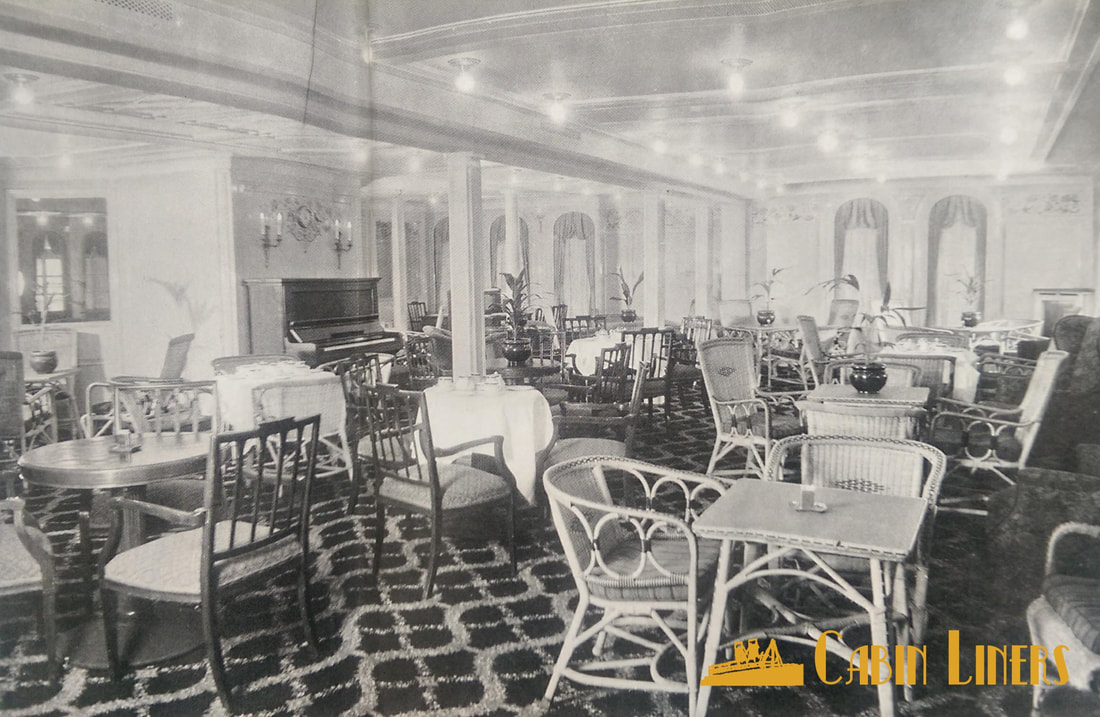
Lounge on B-deck. "To Europe: Majestic, New Tourist Class" brochure; c.1931.
|

Aft Lounge, formerly Tourist-Third Class. Postcard; c.1928.
|
In addition to the principal public rooms, a further large Lounge was provided in a separate deckhouse at the rear of B-deck. Upon her entry into service, this apartment originally contained the Smoking Room and General Room for Third Class Passengers. These were later designated to Tourist-Third Cabin and subsequently pulled together into one large room. The elimination of Tourist-Third put this room as the disposal of the new Tourist Class passengers. The Lounge was exceptionally airy and modern in style, particularly in comparison to the period decor of the other public rooms. This Lounge was decorated with light panelled wood and supplied with wicker easy chairs and small tables. A piano and gramophone as well as a selection of books were provided for the entertainment of passengers.
Tourist Class Reading & Writing Rooms
 Reading & Writing Room on B-deck during Second Class service. "Inside of a Giant White Star Liner" brochure; c.1929.
The Reading & Writing Room was located adjacent to the main Lounge within the principal suite of public rooms. Decorated in much the same style, it was panelled in white-painted wooden panelling and fitted with a generous number of large windows. The interior walls were fitted with large mirrors to increase the sense of spaciousness throughout the room. Writing desks, each seating four persons, were placed along the windows, allowing passengers to enjoy the view out across the promenade deck whilst engaging in letter writing during the voyage. The room was also furnished with a large number of armchairs and club-chairs upholstered in light fabrics. Potted plants and decorative sconces added to the atmosphere of this welcoming apartment. At the forward end of the room, a large cabinet was fitted to hold the supply of stationary and writing paper provided for the convenience of passengers. In addition to this room, a further Reading & Writing Room was located aft of the Dining Saloon on C-deck. A later addition built for Tourist-Third Cabin, it was decorated in a much simpler style.
Tourist Class Staterooms
 Two-berth Stateroom, formerly Second Class. "To Europe: Majestic, New Tourist Class" Brochure; c.1931.
Passengers traveling in Tourist Class were mostly accommodated in the former Second Class staterooms located across A-deck and on C-deck through F-deck. All staterooms accommodate two or four passengers. Whilst two berth rooms were typically fitted with wooden berths, four berth rooms often made use of Pullman bunks which were fitted above settees. The decor was bright, airy, and modern with white walls and ceilings, bright linoleum flooring, and furniture in oak or dark teak. Every room was fitted with a large washstand supplying running water, a generously sized wardrobe, and either a large fitted settee or folding chair. Modern lighting, electric heating, and up-to-date ventilation systems ensured that the staterooms were kept airy, warm, and comfortable in all weather conditions. A number of staterooms on Decks 'E' and 'F' were formerly used by Third Class passengers. Although much plainer in style than their Second Class counterparts, these were heavily modernized for the convenience of Tourist-Third (later Tourist Class) passengers, being equipped with running water, refitted with modern wooden berths, and redecorated in fresher styles.
Tourist Class Dining Saloons
Located on Deck 'D' was the principle Dining Saloon for Tourist Class passengers. Formerly designated Second Class, this room was the full width of the ship, seating two-hundred-and-sixty (1931) diners during any single sitting. This airy and spacious apartment was impressive in both its size and decoration. The room was decorated in a light and elegant classical style. The walls were panelled with delicately detailed white plaster-work whilst the pillars supporting the ceiling were disguised as classical architectural columns. The tables were laid out in small arrangements of two, four, or six seats, an innovation when Majestic first entered service as a great improvement upon the long galley tables that had been standard in the pre-war period. These were accompanied by free-standing individual dining chairs upholstered in leather. Within a niche in the forward wall, decorated in pastel tones with intricate plaster detailing, a piano was fitted for the purpose of divine service. By the 1930s, the room was also capable of being fitted with a movable cinema screen for the entertainment of passengers. A small cinema room was installed in the aft-starboard corner of the apartment to store the equipment for this purpose.
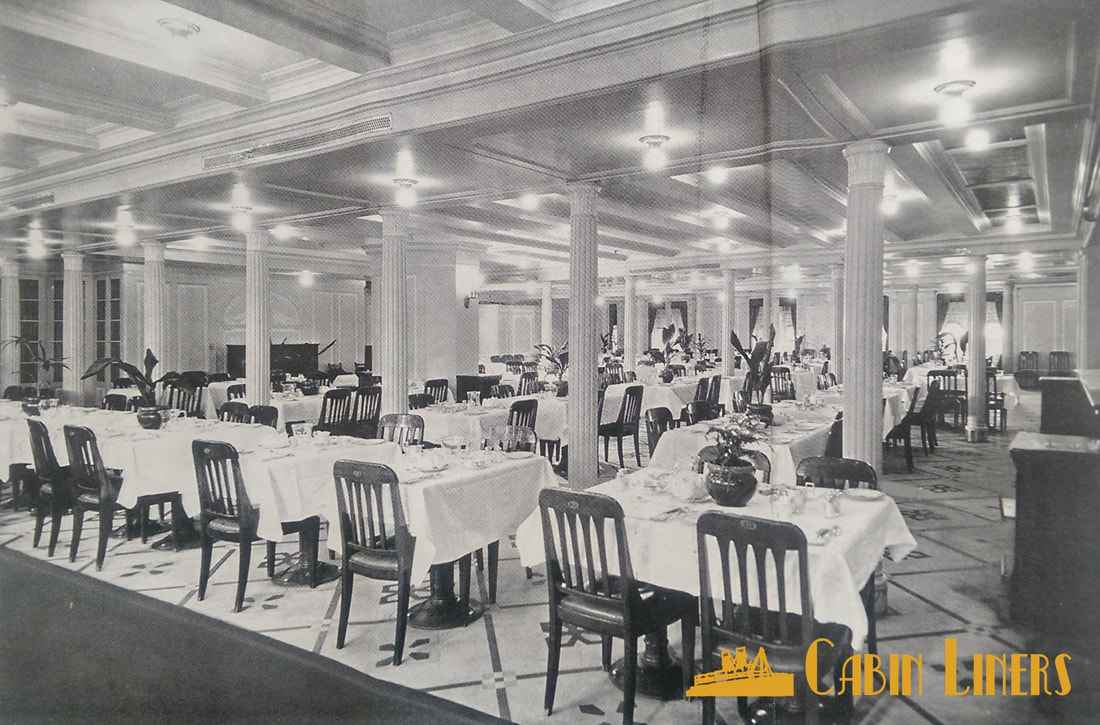
Main Dining Saloon on D-deck, formerly Second Class. "To Europe: Majestic, New Tourist Class" brochure; c.1931.
|
When you and your genial fellow passengers gather around the tables, aglitter with white linens and gleaming silver, you will enjoy the most delicious cooking served by intelligent, courteous stewards. The daily menus are marvels of variety, and, of course, only foods of the highest quality are used in Majestic cuisine. White Star Line Brochure; "to europe: majestic, the new tourist class"; circa 1931 |
As well as the former Second Class Dining Saloon, further seating accommodation was located further aft on C-deck in the former Tourist-Third Cabin Dining Saloon, allowing service for a further two-hundred-and-sixty-four diners if necessary. Although this room was slightly larger than its companion, it was nonetheless still smaller than it had been during the days of Tourist-Third Cabin. The original size of the room had been reduced by moving forward the aft bulkhead to make addition space for a new Children's Playroom and enlarged Reading & Writing Room. This room was simpler in its decoration but still noticeably bright, airy, and comfortable. The wood panelled walls and coffered ceiling were painted and large paintings were hung for decoration. Seating took the form of fixed galley tables although these had been improved by the introduction of portable table leafs and seating between every third place-setting, thus allowing smaller table configurations to be adopted if desired. A dance floor, complete with piano and large wicker sofas, was fitted in the middle of the room, allowing an additional space for evenings entertainment.
Tourist Class Gymnasium
 Gymnasium. "To Europe: Majestic, New Tourist Class" Brochure; c.1931.
Among the numerous leisure activities made available to Tourist Class passengers, a full-equipped gymnasium was provided on B-deck on the port side of the main Entrance Hall. The room was panelled in dark oak with decorative veneer whilst large frosted glass windows allowed in natural light from the promenade deck whilst preserving the privacy of the occupants. The gymnasium contained a full range of the most modern equipment. Entry was free of charge although passengers were sometimes required to collect a ticker from the enquiry office on C-deck to ensure available space. Distinctive opening times were in operation for gentleman, ladies, and children and a fully trained fitness was available during opening hours. A range of deck games were also available outdoors on the Promenade Deck. On C-deck, Tourist Class passengers had also the use of a barbers' shop and ladies hairdresser, with the former being permitted to sell souvenirs to passengers during the voyage.