First Class on R.M.S. Mauretania"... But apart from the question of speed, the 'Mauretania' will remain one of the most striking examples of a happy combination of perfection in naval architecture [...] and of the art of the decorator working with a free hand in design and expenditure." R.M.S. Mauretania, the great transatlantic greyhound of the Cunard Line, retaining the Blue Ribband on both the Eastbound and Westbound runs for 20 years. Combined with her striking yacht-like appearance and the elegance of her Edwardian interiors, she provided her often passengers with a sense of stability, comfort, and sound engineering throughout the 1920s.
|
First Class Library & Writing Room
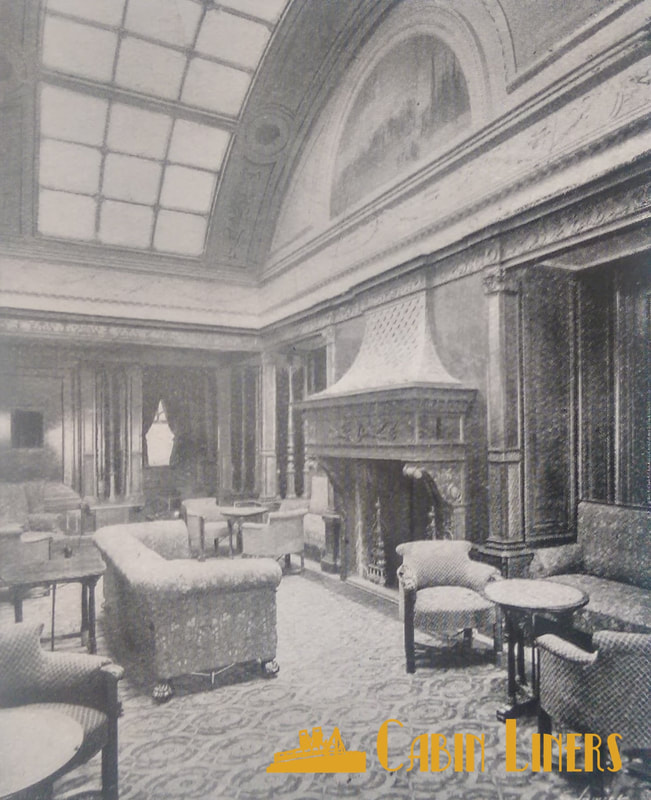
 First Class Library & Writing Room. "The Cunard Turbine-Driven Quadruple-Screw Atlantic Liner 'Mauretania'"; 1907.
The elegant Library & Writing Room, located between the Grand Entrance and the staterooms on the 'Boat Deck', provided a more quiet and intimate atmosphere than the larger Lounge and Smoking Room. Continuous with the other public rooms located further aft, the layout of this apartment was perfectly symmetrical, with glass double-doors on either side connecting with the adjoining rooms. Two spacious bay windows provided views out across the deck as well as allowing in plentiful natural light during the day. This was further enhanced by a large glass dome crowning the ceiling, its wrought iron encasement adorned with bronze-filigree detailing of floral design. The walls were panelled in sycamore painted in a delicate tone of grey with gilded edging. This provided a distinctively light and graceful feel to the decor. The panelling was enhanced by decorative Ionic pillars and rounded niches designed to hold potted plants and fresh flowers. The aft wall of the Library was furnished with a set of tall bookcases which were fitted flush with the wall so as to appear completed seamless with the sycamore panelling. On the wall opposite, the room was fitted with a fireplace carved from pure white statuary marble with a toned ormulu grate. A tall mirror was fitted into the panelling above the mantelpiece to amplify the space and light. The room was furnished with large mahogany armchairs and settees upholstered in a deep shade of rose. A large number of writing desks arranged in pairs were fitted around the outside of the room.
First Class Grand Entrance & Staircase
The Main Staircase connected every level of First Class accommodation rising from the 'Main Deck' where passengers boarded the ship. Each deck landing was fitted with a spacious Entrance Hall allowing access to the public rooms and the staterooms. These landings were decorated in sixteenth century Italian style with woodwork in a series of English and French walnut veneers. This impressive series of spaces was crowned by the particularly large Grand Entrance ajoining the public rooms on the 'Boat Deck', four decks above the lowest level of the staircase. An emphasis on subtle detailing was the marked feature of the wood panelling. Throughout the entire structure, no two sections of woodwork were exactly duplicated but a recurring design was achieved by the series of flat pilasters with carved capitals throughout the design. The flooring consisted of black and white India rubber tiles topped with a green carpet intended to compliment the warm tones of the woodwork.

Boat Deck Entrance Hall. John Adams Postcard; c.1925.
|
The paneling is relieved by carved capitals and pilasters, in which repetition of design has been avoided, and the prevailing impression is one of soft and heavy richness, relieved by the pleasing silvery tone of the aluminium " grille" or railing around the elevators. "The Shipbuilder" magazine; 1907
|
The most striking feature of the Grand Entrance on the Boat Deck was the elegant aluminium grill encasing the elevator shaft. The choice of aluminium saved around twenty tons of weight compared with the more convential use of wrought iron or bronze. This innovation both eased strain on the structure and reduced the impact of weight upon the speed of the vessel, a key consideration in her construction. The two elevators, also panelled in walnut, connected every deck of First Class accommodation. Facing the elevators on the Boat Deck was an impressed carved niche fitted with a recessed settee, creating a convenient lobby area to the adjacent public rooms. This recess was later replaced by a glass fronted kiosk, one of the many small innovations intended to modernise the Edwardian design of the liner for the contemporary passenger market. The area was also improved by the addition of large wicker armchairs and potted plants, give it a stronger sense of being a public room in its own right.
First Class Lounge & Music Room
The Lounge & Music room was located amidships on the Boat Deck aft of the Entrance Hall. This magnificent apartment served as the principle public space for First Class passengers. The room extended over an area eighty feet long by fifty-six feet wide. The space was arranged ingeniously around the funnel casings and ventilator shafts into a large central hall flanked by four seating niches and four semicircular bay windows. Passengers entered the room through beveled glass doors which afforded an excellent view down the adjoining corridors, extending a total length of 350 feet. The Lounge was decorated in the French style of the late eighteenth century. Its wall were predominantly panelled in mahogany which was polished to a tone of rich, dark brown. Each panel was lavishly enhanced by a frame of gold molding. The woodwork was flanked by a series of sixteen 'Fleur de Pêcher' in a distinctive shade of lilac. Fluted columns divided the room into a large central hall with niched areas flanking either side. These were also completed in mahogany with elegant ormolu capitals. The forward wall was fitted with a large fireplace, complete with a white statuary marble mantelpiece and tall mirror. The ceiling was plastered simply in white and crowned by a large wrought iron dome. Together with numerous bronze and crystal electroliers, this ensured a plentiful supply of light at all times.

First Class Lounge & Music Room. Kingsway Postcard s.17752; c.1928.
Although the architecture of the room represented the familiar beauty of Louis XVI style, its unusual yet harmonious colour palette gave it a very unique appearance. The Lounge was supplied with beech furniture in the form of large settees and armchairs arranged around occasional tables. The seating was upholstered in floral brocades of various colours and designs, bringing colour into the room whilst balancing out the duller tones of the mahogany. During the 1920s, Cunard attempted to freshen the room's appearance by installing large potted plants and re-upholstering the furniture in a more modern style. Three large Aubusson tapestries were specially woven for the room and hung on the aft and side walls. The floor was fitted with a Wilton carpet woven in a trellis pattern in shades of green and pink. During her 1922 refit, the central floor was fitted with a parquet dance floor to allow the space to be used as a ballroom. The room was occasionally referred to as the Ballroom in late 1920s advertisements. From her first construction, the Lounge had also been designed to function as a Music Room. A grand piano was fitted on the aft wall along with space for the ship's orchestra to perform concerts.
First Class Smoking Room
|
Further aft of the Lounge & Music room, connected by two small vestibules at either side of the fourth funnel casing, was the Smoking Room for First Class passengers. Extending over an area of approximately two-thousand-five-hundred square feet, the space was divided into two sections by a jubé-style panelled screen. This arrangement was designed to cleverly disguise the numerous ventilator shafts but it also gave the space a unique charm. The sides of the room were divided into eight recesses. The first two were located in the smaller forward section and fitted with writing desks, provided secluded spaces to compose letters. In the large aft section, the recesses were designed as intimate seating areas fitted with card tables and large divan couches. The room was given an impressive feeling of space by its vast wagon-headed ceiling which was constructed from glass panels built into a wooden frame painted in white enamel. Together with a further fourteen large medieval style arched window, this ensured a generous supply of natural daylight to every corner of the room.
|
Forward section and fireplace of the Smoking Room. "The Cunard Turbine-Driven Quadruple-Screw Atlantic Liner 'Mauretania'"; 1907.
|
 Main aft section of the Smoking Room. "The Cunard Turbine-Driven Quadruple-Screw Atlantic Liner 'Mauretania'"; 1907.
This impressive apartment was decorated in the Italian Renaissance style of the sixteenth century, continuous with the design of the Entrance Halls & Staircase but altogether more opulent in its execution. The entire room was panelled in rich French walnut veneer inlaid with delicate chain patterned borders produced from sycamore. Although much lighter than the designs of smoking lounges aboard many other ships, the decorative scheme was sill unmistakably masculine. The room had been constructed for the exclusive use of men although the principle of gender separation in public space was gradually relaxed during the 1920s. The scheme was enhanced by further decorative details. The doors were finished with colonnade-style windows and fitted with brass handles of a distinctive design. An elegant ornamental plasterwork frieze separated the rich wood panelling from the lighter tones of the ceiling. Certainly the most impressive feature of the Smoking Room was the large fireplace on the forward wall. Its chimney piece was lined with two large slabs of green marble whilst the hood above it was elegantly carved in an Italian inspired fish-scale pattern. Its basket grate and fire-dogs were reproduced from originals at Palazzo Varesi in Lodi. Two scenes was painted into either end of the ceiling alcove, with 'Old Liverpool' situated above the fireplace and 'Old New York' at the opposite end of the room above the aft entrance leading to the Verandah café. The Smoking Room was furnished with club-chairs, armchairs, and large settees upholstered in cream and white brocade. The seating was arranged around walnut card-tables topped with dark green leather. A large octagonal shaped table was also placed in the centre of the room.
First Class Verandah Café
The Verandah Café was one the many innovations introduced for First Class passengers when Mauretania first entered service. The room was accessed either directly from the deck or from the Smoking Room, connected through a set of swing doors which led to a communicating corridor. The vision behind this room was to provide a space where passengers could enjoy the feeling of taking refreshments on deck whilst being sheltered from the elements. Whereas three sides of the room were completely enclosed by bulkheads, the aft wall was open to provide views over the decks and the sea beyond. Eight large picture windows provided additional natural light from the sides, whilst the ceiling was crowned by a large skylight trailed with evergreen plants. The room was originally rather spartan in design compared with the other public rooms. Despite being a welcoming idea in theory, the open side of the room did not provide sufficient shelter during rougher weather, nor was the view across the second class decks particularly endearing to her early passengers. The Verandah Café was therefore not particularly popular during Mauretania's early career, with ideas for its replacement being considered by Cunard.
One of the many delightful innovations [...] here passengers may sit and sip their coffee in the open air, perfectly protected from the weather. Evergreens have been trailed across the glazed roof, giving the passenger an impression of shore comforts. "The Shipbuilder" magazine; 1907 |

Refurbished Verandah. Kingsway Postcard c.17755; c.1928.
|
During her 1927 re-fit, the room was completed redecorated in a scheme based on the Orangerie at Hampton Court Palace. The aft wall was fully enclosed by sliding double doors and a steam pipe central heating system was installed. The plain wooden furniture was replaced by comfortable wicker armchairs and large potted plants were placed throughout the space. The decoration of the walls was fully enhanced by fitted trellises and the roof's supporting columns were encased by wooden ionic pillars to complete the scheme. The result was a complete transformation of the room both with regards to its appearance and its popularity among the ship's passengers. The Verandah Café now had the appearance of a interior room, with its original concept maintained by the ability to fully open the new sliding doors during good weather. The space proved to be a particular popular location during her cruising years.
First Class Staterooms
The statements available to Mauretania's First Class passengers were impressive in both their variety and design. Her original 1907 configuration consisted of two-hundred-and-fifty-three staterooms arranged to accommodate between one and three passengers. The finest rooms aboard were the two 'Regal Suites' located on either side of the 'Promenade' B-deck, forward of the promenade and Entrance Hall. Each of these suites embraced a sitting room, a dining room, two staterooms, and a private bathroom connected by a small corridor. The reception rooms of these suites were decorated with walnut and satinwood panelling and hung with panels of silk in rich shades of rose and green. Their bedrooms were Georgian in design, representing the simpler style of the Adams brothers. Further aft overlooking the promenade deck, Mauretania offered eight 'Parlour Suites' composed of a private parlour adjoining an en-suite stateroom. Following the fashions of the Edwardian era, these suites were completed in various period styles, complete with furniture produced from coloured hardwoods such as satinwood, oak, mahogany, and walnut. A further eight staterooms with private bathrooms facilities were offered on 'Boat' A-deck above. The finest staterooms were also connected to the ship's telephone system.


During her refit in 1927, extensive alterations were made to Mauretania's staterooms to meet the expectations of the modern traveler. Although her private bathroom facilities were considered extensive when she entered service in 1907, she was gradually outpaced by newer liners as passengers increasingly considered such facilities to be essential rather than high luxuries. Groups of smaller staterooms were sacrificed in favour of fewer but substantially larger replacements, many with new en-suite bathrooms. First Class passengers now had thirty-five staterooms with private bathrooms in addition to the finer suites. These alterations also improved the general size and decor of these rooms, with Mauretania now offering some of the largest staterooms on the North Atlantic. Bunk berths in the smaller staterooms were replaced by brass bedsteads and pullman berths were cleverly transformed by adding valances to give the appearance of eighteenth-century four-poster beds. Their decorative schemes were updated with new designs including art deco vaneer panelling and 'Marie Antoinette' style painted silk wallpaper. All staterooms in First Class were fitted with hot and cold running water in additional to new heating, lighting, and ventilation systems.
First Class Dining Saloon

First Class Dining Saloon. "The Cunard Turbine-Driven Quadruple-Screw Atlantic Liner 'Mauretania'"; 1907.
|
Spanning across C-deck and D-deck, the First Class Dining Saloon was easily the most impressive apartment aboard Mauretania. The room was divided into an upper and a lower dining space with a vast octagonal well running through the centre. The decor of the Dining Saloon was completed in the French Renaissance style dating from the reign of Francis I. Both sections were panelled in light weathered oak with no panel being an exact duplicate of its neighbour. The lower deck was carved in a more ornate design consisting of arched panels richly decorated with classical motifs. This was balanced by a simpler treatment on the upper deck. Large arched panels and mirrors divided the space neatly into more intimate sections whilst the central opening was completed with an elegant arched balustrade. The crowning feature of the room was the vast plasterwork dome which extended upwards to B-deck, thus creating a three-deck high apartment. Painted in white and gold, its design consisted of interlacing groins linked by plagues depicting signs of the Zodiac. The dome was also cleverly illuminated by concealed lighting. This created a soft glow which bounced from the light tones of the plasterwork and radiated warmly across the room below.
|
Specially pleasing in general effect is the dining-room, with its panelling and pillars in natural creamy oak, its upper gallery and its great central dome with a gilded boss to represent the sun, and a scheme of decoration which displays the signs of the Zodiac around the base.
Cunard Brochure; "The 1927 Mauretania: World's Fastest Passenger Liner"; 1927
The lower dining saloon, extending eighty-seven feet in length, had been designed to accommodate three-hundred-and-twenty-eight passengers in its original configuration. Its upper deck companion was somewhat smaller, seating one-hundred-and-forty-passengers in a sixty-two feet long apartment. Both sections ran the full width of the ship. An innovative feature of the dining saloon service was the introduction of an Á La Carte menu without additional charge. This provided passengers with the benefits of a flexible meal service without the additional cost or social segregation of introducing a separate restaurant. Reflecting this approach, Cunard dispensed with the long galley tables which had been the norm in the pre-war period in favour of table configurations varying between two and twelve diners. Initially concerned with the motion of such a fast liner, the company original retained fixed-swivel chairs bolted to the floor. Following her re-entry into service after the First World War, these were replaced by free-standing armchairs and the table sizes were reduced still further. From the late 1920s, a movable cinema screen was fitted in the room for the purpose of showing 'Talkies' after dinner.