
Tourist Class on R.M.S. MauretaniaIf you're economical of time as well as dollars, save both on the ship that whisks you to Europe in five days. But take out word for it, the voyage will end too soon! Tourist Class replaced Second Class travel aboard Mauretania from 1931 with her entire former Second Class accommodations thereafter being devoted to this new class of travel. Although her Second Class facilities had always been high in quality and comfort, refurbishments in 1926-27 provided her with a more up-to-date finish. These improvements would now be to the benefit of her Tourist Class passengers during her final service years.
|
Tourist Class Lounge
|
The Lounge for Tourist Class (formerly Second Class) passengers was located at the top landing of the main staircase connecting every deck of accommodation in this class. The room was essentially the expansion of the top staircase landing to form a large social space in its own right. The staircase, situated in the centre of the room, was crowned by a circular glass dome which admitted natural light into the Lounge and downward through the vestibule and landings of the decks below. Further light was provided by a series of Venetian windows throughout the room, each consisting of two smaller windows flanking a larger arched window between them.
|
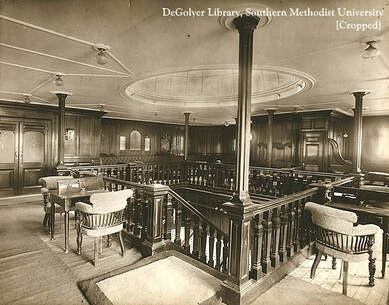
Lounge. Photographed by Bedford Lemere & Co.; 1907. [Credit: DeGolyer Library, Southern Methodist University]
|
The room was panelled in teak carved in a simple expression of the English Palladian style of the late-Eighteenth-century. Around the outside, the room was divided into seven seating alcoves fitted with large settees. A series of paired writing desks were provided around the ballustrade of the staircase. These were accompanied by swivel armchairs fitted to the deck in case of rough seas. The soft furnishings were upholstered in rich floral fabrics appropriate to the decor and the overall scheme was enhanced by the inclusion of potted plants and thick blue carpet runners. The room was supplied with a communicating pantry-bar to facilitate the service of refreshments during the day and after dinner.
Tourist Class Drawing Room
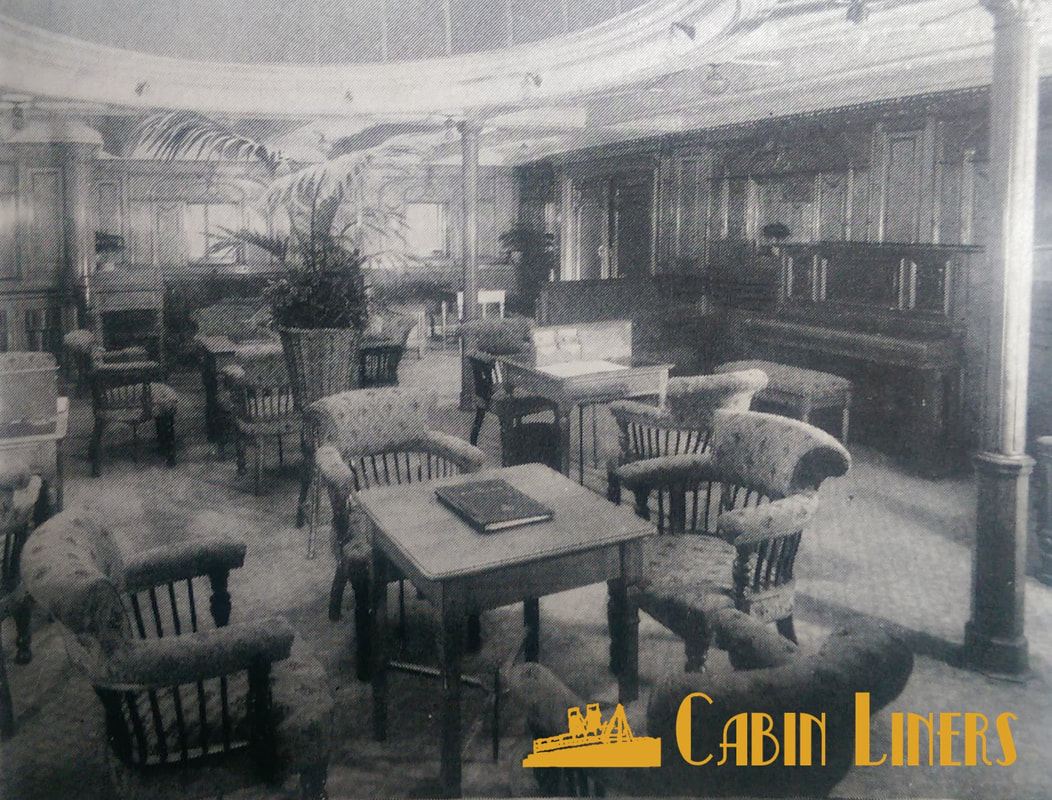
Drawing Room. "Cunard Line: Tourist Class to Europe" brochure; c.1932.
|
Descending down the staircase from the Lounge to B-deck, Tourist Class passengers found two further public rooms at their disposal. The Drawing Room, sometimes known as the Music Room, was located forward of this entrance. The purpose of this room was to provide a more intimate and secluded space than the Lounge, particularly suited to women as a counterpart to the gentlemen only policy of the neighbouring Smoking Room when Mauretania first entered service. The room was completed in the French Neoclassical style of the late-Eighteenth century with light maple panelling embellished with gilded detailing. An illuminated frosted glass and gilded metal dome in addition to wide picture windows provided plenty of natural light.
|
In similarity to the Lounge, the room was furnished with large crimson velvet settees set into seven intimate booths. The original smaller writing tables and swivel armchairs were replaced with more modern alternatives in 1926-27 with lighter floral patterns in their upholstery. An upright piano was fitted on the aft wall for the entertainment of passengers. Fitted bookcases provided passengers with access to a library of classic and modern volumes, magazines, and games which could be borrowed on application to the steward. A gramophone was also fitted in this room during the 1920s. As in other rooms, the decor was also enhanced by the addition of large potted ferns.
Tourist Class Smoking Room
|
The Tourist Class Smoking Room was located aft of the B-deck lobby across from the Drawing Room. Consistent with the culture and use of its Edwardian construction, this room had been designed with a "masculine" aesthetic. The walls were panelled in mahogany inlaid with boxwood and burr mahogany in the late-Georgian (Regency) style. The furniture was upholstered in rich blue velvet to complement the dark tones of the wood panelling. The room was originally fitted with wooden flooring covered by blue carpet runners to match the seating but this was replaced by a more modern and attractive linoleum tiling during the 1927 refit. The furniture was also re-covered in a contemporary striped style of fabric to modernize its appearance.
|

Smoking Room. "The Cunard Turbine-Driven Quadruple-Screw Atlantic Liner 'Mauretania'"; 1907.
|
As in the other two public rooms, the room was crowned by a glass dome, the Smoking Room's being oval in shape and the largest of the three. Double-sized picture windows admitted additional light from the promenade deck. These were covered with elegant etched glass panels which were also fitted within the communicating doors to the staircase and aft lobby. The room was serviced by an adjoining bar located by the aft entrance from the promenade deck.
Tourist Class Staterooms

Two-berth stateroom. "Cunard Line: Tourist Class to Europe" brochure; c.1932.
|
Mauretania provided 133 staterooms for Tourist Class passengers, situated across Upper-C, C, and D-decks. Originally fitted for Second Class passengers, these staterooms had been unusually light and spacious in their design. Each stateroom accommodated either two or four passengers in fixed berths or convertible settees. The walls were decorated in white enamel panelling and the rooms were fitted mahogany furniture, red carpets, and soft wool taffeta curtains. During her extensive refit in 1926-27, the Second Class staterooms were extensively redecorated and refurnished. Hot and cold running water was supplied to every stateroom and traditional washstands with folding basins were replaced by fitted sinks with modern mirrors. The carpets, curtains, and bed linens were replaced by those better suited to modern tastes and enhances by the addition of large rugs and vases of flowers.
|
Tourist Class Dining Saloon

Dining Saloon. "Second Class by Cunard" brochure; c.1925.
|
The dining saloon on C-deck was the largest apartment within the Tourist Class section of the ship. Extending the full width of the ship, the room was furnished in late-18th century English style. Its walls were panelled in light oak carved with decorative fruits and foliage. The panelling was neatly arranged to inset the portholes within arched niches, helping to reduce the feeling of being at sea. The centre of the room was fitted with an octagonal open well with a gallery looking down from the stateroom corridors on Upper-C deck above.
|
The aft wall held a fitted sideboard and china cabinet whilst the corresponding forward wall was fitted with a piano for the purposes of evening's entertainment and divine service. The seating arrangements originally consisted of long refractory tables accompanied by fixed swivel chairs upholstered in green floral tapestry. This fixed-seating arrangement had been the norm when Mauretania entered service in 1907. This arrangement was later improved by replacing the long tables by smaller square and round tables seating anything from two to eight diners. The addition of large potted palms and runner carpets added to the decor.